
Roswell city councilors delayed action on putting a proposed tax increase on the ballot in the Nov. 3 General Election, at least until after a hearing next month.
Following discussion during a special meeting Thursday, July 23, at Roswell City Hall, councilors decided against moving forward with a vote on Resolution 24-16. The resolution, if approved, would place a local option gross receipts tax increase of 0.25% on the ballot. Councilors delayed a vote to amend the proposed ordinance to include a 10-year sunset on the proposed tax hike.
Based on 2026 receipts, the increase would have generated $4.5 million in revenue that year.
Councilors, however, did vote 8-0 to approve Ordinance 26-10, authorizing the city to advertise a public hearing to get input from the public and consider putting the proposed increase on the ballot. Ward 5 Councilor Carlos Marrujo was absent and did not vote on the ordinance. The hearing is scheduled for Thursday, Aug. 13, at 6:30 p.m. at the Chaves County Administrative Building at 1 St. Mary’s Place, in Roswell.
County voters could also be asked to weigh in on a similar local option gross receipts tax increase of one-eighth of 1% in November. Earlier in the day Thursday, the Chaves County Board of Commissioners heard a presentation from Mike Espiritu, president and CEO of the Roswell-Chaves County Economic Development Corporation, on the proposal. The commission did not take any votes on the proposal at the meeting.
The Local Economic Development Act, also known as LEDA, allows municipalities and counties to enact such tax increases through ordinance, if approved by their voters, with the revenue used to support economic development within their jurisdictions.
According to the New Mexico Department of Taxation and Revenue, cities can impose a local option gross receipts tax of up to 0.25% for economic development. Counties can impose a tax of up to one-eighth of 1% for the same purpose.
Espiritu confirmed that city residents would vote on and be subject to both taxes, since the city is within the county. County residents, though, would be subject to and vote only on the county tax.
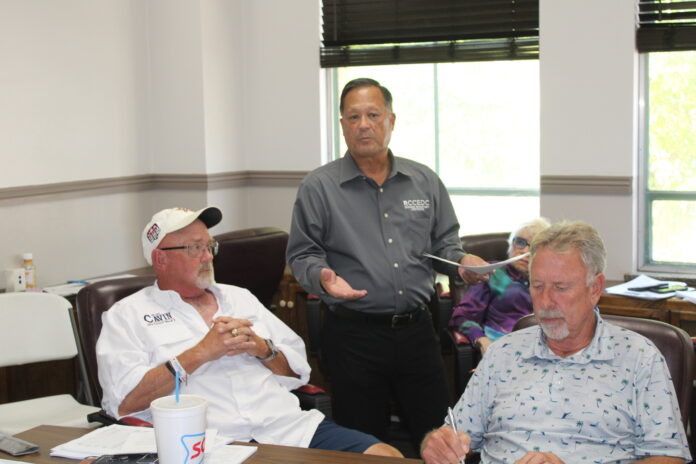
During Thursday’s meeting at City Hall, Espiritu and Kevin Wilson, a Region 6 representative for the New Mexico Economic Development Department, pitched the proposal to councilors. Espiritu said the tax would create revenue to cover costs such as site readiness and infrastructure upgrades on properties where businesses are looking to locate.
“This is what these funds can be used for to help grow our community. And what’s important about this is it’s not just a tax for tax purposes, but it’s really an investment in the future of Roswell and the people that live here,” he said.
Such incentives, Espiritu said, will draw companies to the area, creating jobs, spurring population growth and bringing about a spike in overall local tax revenues. Under state law, the additional revenue generated by the tax would have to be used for economic development. Espiritu said about 50 communities in New Mexico have such a tax.
Wilson added that the money from the local option gross receipts tax could be used as matching funds for grants, to offset the cost of loans and to provide gap funding for some companies.
Wilson noted that under state law, revenue generated by the local option gross receipts tax for economic development must be placed in a fund and used solely for economic development projects and plans.
Espiritu added that revenue would create a consistent stream of funding for economic development for at least the next decade, if the measure is approved. It would allow such public investments to be made without dipping into funds used for other needs.
Ward 1 Councilor Christina Arnold said that while she can see the benefit of the proposal, she noted that it also comes at a time of rising costs and a series of tax and fee increases the city has already imposed. These include tax increments to cover the cost of flood recovery and water fees.
“I just think it’s really that timing,” Arnold said. She also questioned the odds of the measure winning majority voter support.
Ward 2 Councilor Will Cavin acknowledged that people are unhappy about paying more taxes, but if the measure makes it onto the ballot, it’s the voters who will decide whether to approve the tax.
“The beauty of this is that we’re not making this decision. We’re giving the citizens the opportunity to make that decision,” Cavin said.