
When you chat with David Greenwald about archaeology, he doesn’t describe the field as a passion, an area of expertise or a career that he’s spent decades pursuing.
For Greenwald, the president and founder of the Jornada Research Institute, his work is much more than that.
“Archaeology, that’s been my life,” said Greenwald, who will deliver a lecture at the New Mexico Museum of Space History on September 4. “I kind of grew up around it.
“I grew up in Wyoming and there were archaeology materials just about everywhere up there. But it wasn’t until I went to college that I got really interested in the subject.”
Greenwald, a graduate of the University of Northern Colorado, has spent 50 years studying Southwestern archaeology, and for the last two decades, he has become one of the principal stewards of one of New Mexico’s best-kept archaeology sites.
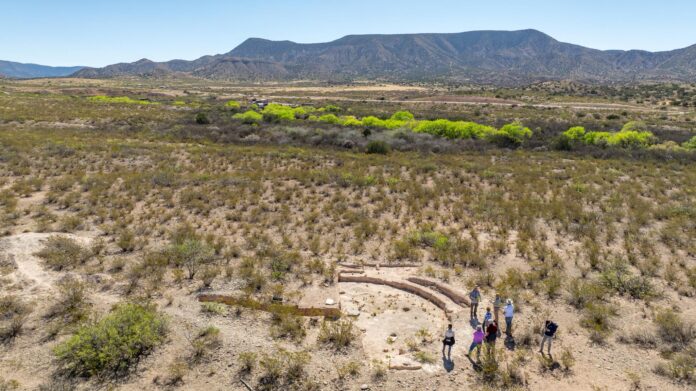
Greenwald discovered Creekside Village in Tularosa Canyon in 2004, and for the last 22 years, he’s been busy unearthing secrets about the Jornada Mogollon people who lived there. The discovery of Creekside Village represented the first time a Great Kiva has been found in the Tularosa Basin, and subsequent investigations have pinpointed the approximate time of inhabitation to sometime between 500 and 900 AD.
“Archaeologists who are originally working in this area saw these people as being highly mobile, collectors and gatherers,” said Greenwald. “The word ‘jornada’ is Spanish for journey. in their perspective, they were constantly on the move exploiting resources as they became available in one resource zone and then going higher as resources became available at higher elevations. And then they would repeat that whole process.”
Greenwald said that the Jornada Mogollon people were harvesting plants such as chenopodium, amaranth and mesquite pods for their food supply.

He went into great detail on the subject during a recent lecture at Otero Arts entitled Settlement Complexity and the Role of Great Kivas in Tularosa Canyon, but on Friday, he’ll focus specifically on the great kiva’s use as an ancient horizon calendar.
At first, Greenwald said, the only information he had about the kiva was that it was a great depression in the ground. He found that it had a raised berm around the exterior, which indicated that perhaps it was evidence of humans digging and throwing the dirt out.
The only way to learn more, he decided, was to dig. So he got the permission of the landowner, and he began investigating the evidence left inside the ground.
The remnants of the site were less than three feet deep, Greenwald said, and they began to uncover evidence that included burnt beams and oxidized adobe.
“One of the things that we ran into was a large slab lying there in the bottom of our first two units that we dug. And on top of the slab was this burnt layer,” he said. “Once we got the edges cleaned around the slab, we could see there was also a burnt layer under the slab, which suggests that the slab was standing upright. And when the roof collapsed, it knocked it over. Some of the roofing material had already fallen onto the floor.”
Once he had established that the remains were architectural, Greenwald was free to examine other elements of the site. Its location, at first, didn’t make sense to him because it was on a slope that would’ve necessitated harder construction than surrounding areas.
But as he began to dig trenches out in all directions from the great kiva, he found the Great Kiva’s bench and its support posts. And in the center, he found the central hearth.
“They probably figured out that particular location, and took a rope marked on the ground the diameter that they wanted to build. And they used the hearth as the center point,” he said. “And we continued to ask the question, ‘Well, why did they dig it here when they could have gone 30 or 50 meters to the north and it was really easy digging up there?’”
Time, and technology, helped answer that question. The archaeologists began making observations, and they noted that from the center of the great kiva, the sun in the summer solstice would rise on the far horizon to a specific notch. Then they made observations on a cloudless night around the winter solstice to see if the Great Kiva had a view of that.
“By that time, we had done more excavation. We had defined the entry way to the Great Kiva. It was on the southeast side,” he said. “If you’re standing at the center of the kiva, at the hearth, and looking right through the center of the entry way, on the winter solstice, the sun rises from another notch on the horizon in line with the hearth in the center of the entry way. So, we had the two points that came together at that exact location.”
Greenwald said the archaeologists eventually used a cell phone app, Stellarium, to go back in time and measure the lunar maximum position in 704 AD. Greenwald and company observed the maximum lunar position in 2024 from the site and found that between 704 and the modern day, the measurement for the lunar maximum was only off by 2 degrees.
“Based on naked eye observation,” he said, “You would not be able to tell that.”
What are the implications of this knowledge? What did ancient people know from the position of the sun and the moon and how did it impact their seasonal lives?
“On that horizon, there’s saddles, there’s notches and there’s small pointed conical landforms. Little valleys and then a long plateau,” he said. “The equinox position from the Great Kiva is right at the end of the north end of that plateau, right as it starts to drop into another saddle. That’s an easy point for them to recognize like the conical landforms and notches. They would know that represents a specific time of the year.”
From there, by extension, they knew when to plant and when to harvest their crops.
“They’re using that entire horizon like what Hopi and Zuni and Acoma [tribes] have used for hundreds of years,” he said.
“They keep time by watching the sun’s movement across that horizon. From that, they will know when the last threat of spring frost would occur and they would know when the first threat of a killing frost would likely occur in the fall. And those are very prominent positions on that horizon. They know when it’s safe to plant.”
To learn more about the Jornada Mogollon, you can attend David Greenwald’s Launch Pad Lecture at the New Mexico of Museum of Space History. The lecture, entitled Astronomical Significance of the Creekside Village Great Kiva: Prehistoric Time Keeping, will occur at 9 a.m. on September 4 at the New Horizons Dome Theater and Planetarium.