An elevator plunging to the bottom of a nuclear waste repository was the latest in a series of problems with the site’s hoist system.
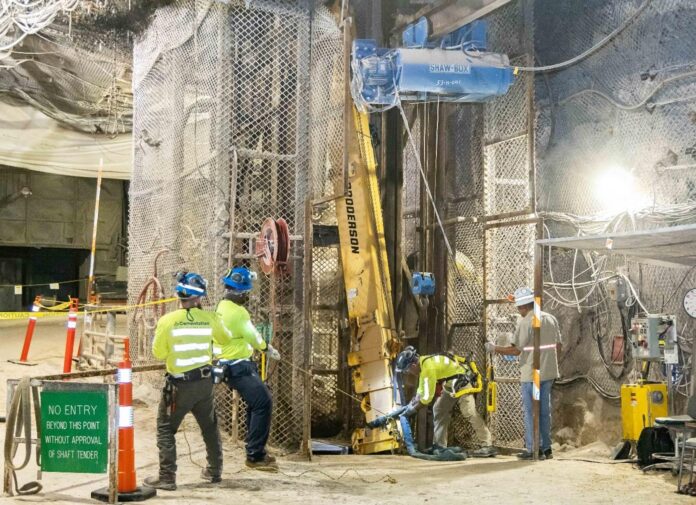
The five-person lift, functioning as an emergency egress in an air intake shaft at the Waste Isolation Pilot Plant fell about 1,600 feet Aug. 19 into the underground after a metal rope became entangled and snapped during a routine test, officials said, smashing the car to pieces.
No one was hurt in the incident, but it set off a wave of alarm among WIPP employees voiced by their union, the United Steel Workers, while officials with the U.S. Department of Energy and contractor Salado Isolation Mining Contractors (SIMCO) sought to minimize concerns about the risk in the underground.
At WIPP, the Energy Department disposes of transuranic (TRU) nuclear waste, which is clothing materials, equipment and other debris irradiated during nuclear activities.
The waste is buried at WIPP in a salt deposit about 2,000 feet underground. The salt gradually collapses on the waste, burying the refuse and blocking radiation from escaping.
Disposing of the waste requires the use of a series of four elevators at WIPP. The main elevator, known as the “waste hoist,” can both lower waste into the mine and carry about 75 people to and from the surface.
Other hoists such as those at the salt shaft, which is also used to move mined salt out of the underground, and the air intake, function as emergency egresses should the waste hoist be taken out of service.
Another shaft, known as the “Utility Shaft,” was recently completed and was put into service for WIPP’s emergency egress as the air intake shaft is being repaired following the recent incident.
The Utility Shaft also functions to draw air into the mine, as part of a recent rebuild of WIPP’s ventilation system on the west end of the mine.
The salt shaft is also out of service – potentially until November – as its motor is being replaced, said James Cobb, president of the United Steel Workers Local 12-9477.
The union also represents workers at other energy department sites that send waste to WIPP including the Hanford Site in Washington and Idaho National Laboratory.
Cobb works at WIPP as a hoistman, operating the hoist system at the repository. He’s worked there since April 2022 and said the collapse of the air intake shaft’s hoist was indicative of much worse problems with the safety culture at WIPP and among officials at the energy department and SIMCO.
The union boss said federal officials and contractors entrusted with the safety of WIPP workers are putting production – the speed of nuclear waste disposal – over worker safety.
“The guys were scared to get on it,” Cobb said of the small hoist days after it collapsed. “They told us the rope could never break. If it breaks, it’s gone. You have the right to say no.”
‘Serious issues’
Don Hancock, nuclear waste program manager at Albuquerque-based government watchdog group Southwest Research and Information Center, said the incident and the lack of a public announcement were indicative of WIPP’s lack of transparency.
He pointed to an unplanned, two-month pause of waste disposal in May and June when the salt and air intake shafts were taken out of service for repairs April 15 and April 28, respectively, according to a May 14 report from the Defense Nuclear Facilities Safety, an independent federal watchdog agency.
That was after WIPP’s annual two-month maintenance outage from January to March, after which officials touted more than 100 projects completed, including upgrades to electrical substations and communications technology in the underground.
Hancock said no public announcement was published for the May to June pause, nor for the elevator collapse. He said such incidents should be reported and explained to the broader community surrounding WIPP, rather than following the minimum required for government reports to the New Mexico Environment Department and other oversight agencies.
“The main thing that’s going on is that the Department of Energy and SIMCO are not being forthright with the public,” Hancock said. “There are serious issues with the hoists. They publicize things they think are good things, but they should also publicize problems and put out reports that are full and accurate.”
He said the recent incident was troubling given the multiple recent maintenance outages at WIPP.
“These concerns have been raised repeatedly, and they said they fixed them; they have not,” Hancock said.
In an emailed statement, the Energy Department countered that WIPP’s hoists go through rigorous testing to ensure their safe operation. The agency said the incident on Aug. 19 occurred during a test after the hoist was taken out of service in April for maintenance.
No workers were present in the area where the hoist fell, the Department of Energy stated, due to barriers and other safety precautions arranged during the test. Operations around the hoist were halted and remained paused as the cause of the incident was investigated.
No final determination for what caused the collapse was reported as of press time.
“Given the significance of the event, all work in the underground was immediately paused to communicate with employees about the event and assess the situation,” the statement read.
The continuous problems with the hoists were expressed in two government watchdog reports last year: a June 25, 2025, report from the U.S. Government Accountability Office (GAO), and a June 18, 2025, report by the Defense Nuclear Facilities Safety Board.
Both agencies noted the “degraded” state of the lifts and questioned worker safety.
That led to the New Mexico Environment Department issuing an administrative compliance order later that month, calling for the federal agency to take a series of corrective actions and provide a schedule for such activities, including “no fines or punitive measures.”
SIMCO denied the allegations in the order, calling for a public hearing that was held June 2-3 of this year in Santa Fe before the Environment Department. The department has yet to issue a final ruling.
During the hearing, Sheila Davis, SIMCO vice president of environmental safety, denied any problems with the hoists at WIPP and contended that “If we have aging issues, those are addressed with the responsible managers.”
Less than three months later, the air intake hoist collapsed.
Because the collapse occurred during a test, the incident did not pose any implications for a violation of the state’s permit, said Kyle Staggs, resource protection compliance enforcement bureau chief at the New Mexico Environment Department. He said the compliance order was still being discussed internally by the agency.
Staggs said worker safety is paramount, and that the collapse, which Staggs said was reported to the state within hours, could have been much worse if it occurred during normal operations.
“Not that anything crashing to the bottom of the mine is a good thing, but it could have been very bad, and it wasn’t,” he said. “This is a lot less bad than it could have been.”
Staggs said the testing was necessary as WIPP works to upgrade its infrastructure in support of waste disposal operations expected to last until 2080.
“They’re working through the process of replacing and updating a lot of this infrastructure around the hoists,” he said. “It reads like there’s an understanding that the infrastructure needs updating and that’s what they’re pursuing.
“I don’t think any agency wants to have workers in unsafe conditions, unless they’re being foolish.”
‘Production over safety?’
In the meantime, the repository is using the Utility Shaft as its emergency escape in case of an incident, but it presents similar issues, Cobb said.
That’s because the recently completed, $100 million shaft was not outfitted with automatic breaking mechanisms known as “safety dogs.”
The dogs function using an electronic sensor that can tell if there is any slack suddenly in the lift’s rope, indicating a lack of tension and a potential break. The device immediately grabs onto wooden guides installed throughout the shaft using metal spikes, stopping the hoist car and ensuring it can travel no further.
The Air Intake Shaft where the car recently collapsed was not outfitted with the wooden railing or the devices, nor was the Utility Shaft. Cobb charged that WIPP leadership failed to do so to save money as those shafts are only used “in emergencies,” unlike the daily-used waste shaft where they were installed.
It’s another layer of safety, he said, that is needed to protect human life in case of catastrophe.
“Everything is lining up for something tragic to happen; the precursors are there,” Cobb said. “Does it have to kill somebody for you to change your way of operating? I know it’s production over safety.”
The Department of Energy explained that the safety dogs are never installed on elevators that use rope guides instead of the rigid wooden guides used at the much larger waste shaft, which can hold more than 100 people in an emergency compared with five to eight in the emergency lifts.
“Safety dogs can only be utilized on a hoist with rigid wooden guides; therefore, safety dogs cannot be installed on hoists with rope guides,” the statement said. “All hoists at WIPP are fully compliant with all regulations, are routinely monitored and inspected by SIMCO personnel and inspected on a quarterly basis by MSHA (New Mexico Mine Safety and Health Administration).”
Work is underway on WIPP’s “Hoisting Capability Project,” read the statement, which will result in a full replacement of the lift at the Air Intake Shaft followed by the Utility Shaft. That will likely lead to a pause of WIPP’s operations next year while the work is completed.
But it won’t come soon enough for Cobb and WIPP’s workforce, he said.
“We’re at a point where they should be able to expedite it,” he said. “There’s no reason the problems they have right now don’t justify it.”
Managing Editor Adrian Hedden can be reached at 575-628-5516, or @AdrianHedden on the social media platform X.