Nuclear waste officials reported increased shipments of waste from within New Mexico to a repository near Carlsbad.
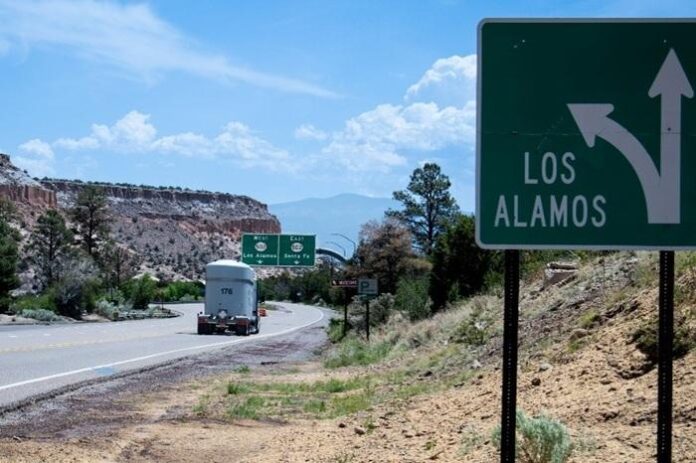
The U.S. Department of Energy said Monday, Sept. 14, that it sent 82 shipments of nuclear waste from Los Alamos National Laboratory in northern New Mexico to the Waste Isolation Pilot Plant through Fiscal Year 2026.
The announcement came as the federal government and the state of New Mexico are considering a modification to WIPP’s operations permit that would require the facility to increase disposal of waste from within the state, specifically from Los Alamos.
At WIPP, the Energy Department disposes of transuranic (TRU) nuclear waste, which is clothing materials, equipment and other debris irradiated during nuclear activities.
The waste is buried at WIPP in a salt deposit about 2,000 feet underground. The salt gradually collapses on the waste, burying the refuse and blocking radiation from escaping.
The 82 shipments sent from Los Alamos to WIPP in Fiscal Year 2026 marked a 91% increase from FY 2025’s total of 43 shipments. Fiscal Year 2024 saw 49 shipments from Los Alamos, and FY 2023 had 68 shipments from the lab, meaning that year marked a 39% decline.
There were 79 Los Alamos shipments in FY 2022 and 56 in FY 2021.
Federal fiscal years run from Oct. 1 to Sept 30 and are named for the calendar year they end in.
The FY 2026 waste shipments from Los Alamos consisted of 370 cubic meters of waste, enough to fill 46 standard dump trucks, according to a news release from the Department of Energy.
And all the shipments, the release read, were “legacy waste,” loosely defined as waste produced before Oct. 1, 1999 – the year WIPP began accepting shipments from across the U.S.
Notably, much of the waste came from corrugated metal pipes that were dug up at Los Alamos and cut into pieces to fit within the 55-gallon drums used to ship waste to WIPP.
The pipe waste was generated and buried onsite between 1975 and 1978 and fully exhumed for processing in 2024.
The pipes contain concrete encasing liquid plutonium used in weapons development and nuclear research at Los Alamos.
Once waste is packaged for shipment to WIPP, it is analyzed via the WIPP Central Characterization program, which sees WIPP staff both at the lab and repository evaluate the contents of waste shipments to ensure they meet federal standards.
Overall, waste from within New Mexico to WIPP accounted for about 12.5%, or 1,860 shipments – 1,850 from Los Alamos and 10 from Sandia National Laboratory in Albuquerque since 1999.
Most of WIPP’s waste came from Idaho National Laboratory, which sent 7,849 shipments or about 52.8% of WIPP’s overall waste.
That’s because of a 1995 agreement between the Energy Department and the state of Idaho stipulating that half of WIPP’s shipment capacity would be reserved for Idaho shipments as the federal government works to clean up waste at the lab.
But the high percentage of out-of-state waste being sent to WIPP was a sticking point for the state of New Mexico and its Environment Department, which in April sought to modify WIPP’s state permit to increase Los Alamos shipments.
The permit modification proposed by the state would require that half of WIPP’s shipments come from Los Alamos by 2027, and 75% by 2031.
Environment Department Cabinet Secretary James Kenney said the intention was to “strengthen” the federal government’s commitment to using WIPP for the benefit of New Mexico, while pressuring the Energy Department to put more resources toward cleaning up Los Alamos.
Increased shipments were recently announced from the Department of Energy’s Hanford Site in the state of Washington, and the Savannah River Site in South Carolina. Don Hancock with the Albuquerque-based Southwest Research and Information Center said this indicated that the federal government was not focused on prioritizing New Mexico waste.
He contended that with 87.5% of WIPP’s waste coming from outside New Mexico, it was clear the Energy Department was serving out-of-state interests over the repository’s host state.
Specifically, he pointed to recent shipments from Savannah River of weapons grade plutonium that was “down blended,” a process of diluting the waste to a lower level of radioactivity to make it compatible with WIPP’s acceptance criteria.
That is not New Mexico waste, Hancock charged, and not the legacy waste he said should be WIPP’s primary focus.
“DOE needs to weigh these priorities and explain to the public what they are doing and why,” Hancock said. “They’re shipping waste they want to ship, but most of it does not need to be shipped. It’s not all legacy waste.”
Managing Editor Adrian Hedden can be reached at 575-628-5516, or @AdrianHedden on the social media platform X.