
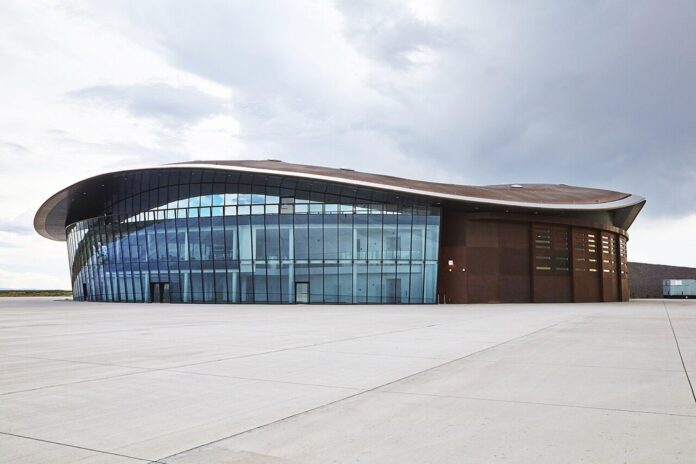
Some projects are born years or decades ahead of their time. And some come to fruition right when external circumstances allow them to prosper.
New Mexico’s Spaceport America, which bills itself as the world’s first purpose-built spaceport, was studied for its feasibility all the way back in the 90’s, and developments in technology helped to bring it into existence by 2011.
Just five years ago, in 2021, Spaceport’s principal tenant, Virgin Galactic, sent three humans into space and New Mexico became just the third state to earn that distinction.
Now, with New Mexico on the forefront of several other exciting technologies, Spaceport America finds itself at an interesting juncture. The returns of commercial space exploration are just beginning to show themselves and could grow exponentially over time.
“I think it’s very fitting for New Mexico to be in the middle of this,” said Scott McLaughlin, the executive director of Spaceport America, who will be holding a lecture at the New Mexico Museum of Space History on Friday. “Maybe the space part was a little too soon in terms of the commercial space world. But right now, if you go to Florida, there’s a launch about every two days. Most people would never guess that. And sometime after 2030, there will probably be a launch once a day or so at Cape Canaveral.”
McLaughlin, born in Albuquerque and a New Mexico State University graduate, never expected to be able to pursue his dreams of working in space and living in New Mexico.
He worked out at White Sands in the beginning of his career, but he left the state and lived in Colorado and Texas before returning to New Mexico in 2018. He was hired as an engineer at Spaceport America in 2019 and promoted to the facility’s executive director in 2021.
And now, he finds himself embarking on a charm offensive. McLaughlin is serving as an ambassador for both his home state and the space industry, and he says that he finds himself confronting misinformation about what Spaceport America is all about.
“I think I’m finding that most people unfortunately have kind of a negative perception of the Spaceport,” he said. “I have to help them understand that actually a lot’s been going on.
“We done some economic impact studies, and so we can prove that there’s been a significant amount of economic impact and a significant amount of jobs.”
Spaceport America’s 2025 annual report indicates that the facility generated $122 million in new money and supported 985 jobs in the calendar year 2023. Over a six-year span, Spaceport America is believed to have added $491 million in value-added production.
“We’ve been raising the number of customers that we’re in contact with every year,” McLaughlin said. “In the last two or three years, we’ve actually been able to enter much more into the Department of Defense world so that we’re getting some of the big names that you might imagine. Raytheon, Boeing, Lockheed-Martin.
“Those kind of guys are coming out here to do testing at the Spaceport of various kinds, and then our big customer right now that’s been kind of exciting to watch is Hermeus. They’re building a remotely controlled and autonomous faster than sound vehicle.”
McLaughin said that the Hermes project is indicative of a larger trend. The Hermeus hypersonic vehicle can take off and take care of all its maintenance at Spaceport America, and it can also take advantage of restricted airspace at White Sands Missile Range.
“We’re ahead of so many other states,” McLaughlin said. “If you look at other states like Arizona, Utah, Texas, they’re all trying to put together some sort of commercial space port, but none of them have access to the restricted air space and wide open spaces that we do surrounded by public lands. …It’s very unique and it does make it very special. Hermeus needs restricted air space to be able to fly. It would be difficult to fly in normal FAA air space, but being able to be able to fly in the White Sands Missile Range air space is what allows that and many of our other customers to fly where they are.”
Virgin Galactic is scheduled to bring two of its Delta spacecraft for testing at Spaceport America over the next few months. McLaughlin said that Virgin will start with simple drop testing, which means dropping the craft and letting it glide back to the Spaceport.
After that, McLaughlin said, Virgin will light the engine for varying amounts of time and then turn it off and let it land again. Eventually, the plan is to send the Delta craft into space with two pilots, at which point it will be able to be certified to start carrying passengers again.
McLaughlin said that Spaceport America already has the facilities to house the Delta spacecraft, but Virgin Galactic may be willing to build a new hangar for them.
“Right now, they have to fuel the spaceship out on the runway with it attached to the mothership,” McLaughlin said of the current lay of the land. “They want to build a hangar where they can fuel it inside the hangar. That’s the project that we’re discussing with them. And we’re not there in terms of an agreement yet, but sometime I think in the next six months we’ll probably have them start building a new hangar, we hope, at their expense.
Interestingly, the architects of Spaceport America didn’t necessarily identify future trends. McLaughlin said it would’ve been difficult or impossible for anybody to envision the huge role that private enterprise has taken in the world of space travel.
Spaceport America’s construction required a leap of faith for a government to make, and it just so happened that it occurred at a great timing of circumstance.
SpaceX was the first commercial company to be capable of bringing astronauts into space, and McLaughlin said that spurred a huge growth in investment from other private companies.
“I think it’s a natural evolution that also has a natural tension,” he said. “Government doesn’t like to give up the things that it thinks it’s good at, but private industry also doesn’t like to take the risks that government takes. No private company in the 1960s would have raised their hand and said, ‘Hey, I’ll build my own Saturn 5 rocket.’
“They didn’t understand the risk, but now Hermeus is funded by private capital. Of course, Blue Origin is also funded by private capital. There’s a great symbiosis where the government starts off these technologies and takes on risk, and once they’ve worked out the kinks and come up with a good formula, then it can start to be duplicated and iterated on in private industry.”