
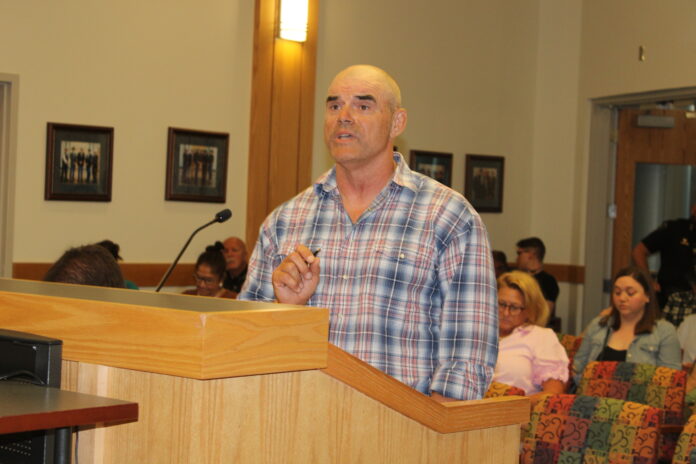
Digital license plate readers were the subject of a tense discussion during Thursday’s Roswell City Council meeting.
For several days, the Automatic License Plate Readers (ALPRs) cameras have drawn scrutiny from local residents on social media, even as the Roswell Police Department defends them as tools to enhance public safety.
Residents took those concerns directly to the council by offering public comment on the ALPRs. In remarks to the council, resident Brian Davis compared the use of the ALPRs to “1984,” the classic George Orwell novel about an autocratic surveillance state.
City councilors did not take any official action on the matter but entertained a public discussion during the meeting to receive feedback from local residents. Ward 1 City Councilor Christina Arnold suggested the city’s Public Safety Committee should have more discussions about how the police how the ALPRs are used and form a policy about it moving forward.
“I mean, Big Brother surveillance, I’m terrified of that,” Davis said.
The equipment was purchased with part of a $1.4 million state grant the city received in December 2025 for the RPD’s Real-Time Crime Center, according to a Thursday social media post by the RPD before the council meeting. The center uses streaming video on cameras throughout the city to collect evidence in cases and provide officers with information to better respond to emergency service calls.
ALPRs use AI technology and roadside cameras to scan the license plates of passing vehicles, and collect data on a vehicle’s make, model and color. The information is stored in a searchable database that can be matched against federal and state warrant lists.
Lt. Michael Fry of the Roswell Police Department’s Special Projects Division gave a presentation at the meeting about ALPRs. In his remarks, Fry said 23 ALPRs have been installed in high-traffic thoroughfares across the city as part of a five-year, $477,119 contract with Axon, a company that has provided the RPD with body-worn cameras.
The RPD is not currently sharing ALPR data with other law enforcement agencies, but Fry said the agency could do so once staff becomes more familiar with the technology. He added that Roswell police do not intend to release information gathered to third parties.
Fry also disputed claims on social media that ALPRs can look inside vehicles, hack into a phone’s Wi-Fi, listen in on conversations or use pattern prediction features to predict crime based on past data.
“These are all terms that I’ve seen on Facebook in comments, and they are all just flat-out wrong,” he said. The ALPRs also do not track speed, only take still images of license plates and Axon does not have a national license plate database.
The ALPRs, Fry said in his presentation, do have safeguards against abuse. All police officers must provide an active case number to access the data, and audits will also be routinely conducted to screen for any kind of misuse.
Resident Bernadette Luna told councilors she supports the ALPRs.
Luna credited surveillance cameras with aiding in the investigation of her 15-year-old Cameron Luna’s murder in 2022. Cameron Luna and his friend Jorge Armendariz, 16, were found shot to death in Cahoon Park and Carlos Gallegos, 18, was arrested and charged with the killing.
Gallegos, who was 15 at the time of the shooting was convicted in November 2024 on two counts of first-degree murder and one count each of armed robbery, conspiracy to commit armed robbery, and unlawful possession of a handgun by a person under the age of 19. He was sentenced in February to two life sentences.
Two other teenagers: Jayvin Montoya, 17 at the time and Damian Romero, 15 at the time were also convicted in 2024 of the same charges for their roles in the shooting. A fourth defendant David Salas-Silva, 18, pleaded guilty to tampering with evidence and was sentenced to two years’ probation.
Evidence gathered through surveillance helped build evidence, Luna said, leading to the convictions.
“So I think it’s going to be really beneficial and it’s really going to help with the crime,” Luna said.
But critics at the meeting urged the council to reverse course on the ALPRs.
Christian Ehmling urged councilors to tear down the cameras, especially one that he said “points directly into a yard where kids are always playing.”
A military veteran and retired law enforcement officer, Richard Swete said that one such camera is located several doors down from his house and he wants it removed.
“It’s severe government overreach, it’s absolutely ridiculous,” he said. If the ALPRs are used at all, he said they should be on major roadways, such as U.S. Highway 285, instead of residential areas.
“If you want to track me going to the gym in the morning that’s cool, but I guarantee you, none of you want that camera two houses down, seeing who leaves your home at all hours of the night,” Swete said.