
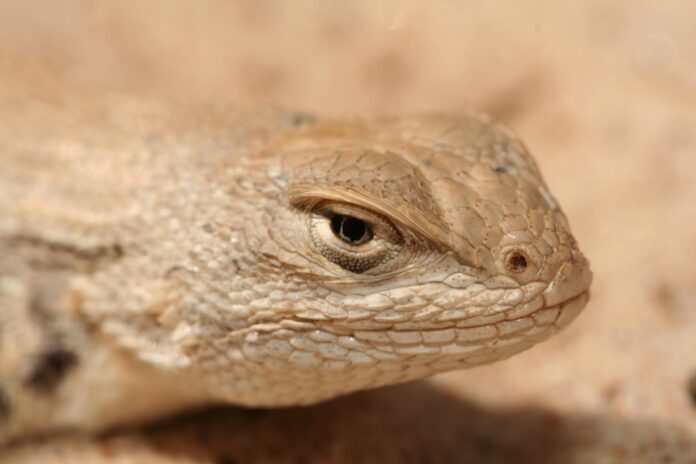
The dunes sagebrush lizard crawls through the sand dunes of the Permian Basin in southeast New Mexico and West Texas.
It’s a small lizard, growing to about 3 inches long, according to the U.S. Fish and Wildlife Service, and its range stretches as far north as Curry County, New Mexico, and as far south as Odessa, Texas.
Despite its miniscule stature, the sagebrush lizard is at the center of a multi-year legal battle over tactics to protect the species from extinction. The dispute most recently took the form of an appeal filed Friday, Aug. 14, by an environmental group hoping to restore the lizard’s federal status as an endangered species.
That classification was conferred on the lizard in 2024, requiring the federal government to develop a recovery plan, set aside lands for the species to repopulate and restrict development in its habitat.
The endangered listing came in response to a 2018 petition from the Washington, D.C.-based Center for Biological Diversity and a subsequent lawsuit, which led the species to be proposed as endangered in 2022 and listed two years later.
But in July the agency filed a motion in federal court asking a judge to vacate its prior decision in response to a lawsuit filed in 2024 by the state of Texas.
Under the Endangered Species Act, “endangered” status means the agency believes extinction is imminent. The lower “threatened” status also restricts development in certain areas and indicates an endangered listing may soon be warranted.
The agency initially opposed Texas’ argument that the listing, granted during the Democratic administration of former President Joe Biden, was not warranted. But under Biden’s Republican successor Donald Trump, the service’s parent agency the U.S. Department of Interior changed course, signing a settlement with the state to cancel the listing.
On July 21, U.S. District Judge David Counts approved the settlement in U.S. District Court for the Western District of Texas.
That was the ruling appealed Aug. 14 by the Center for Biological Diversity.
The initial notice of appeal did not outline why the center believed the court acted illegally and should reverse its decision but called for the listing decision to be remanded back to the agency, potentially leading to another 12-month finding required for species protections.
Jason Rylander, an attorney with the center, said population estimates showed the lizard’s numbers had declined significantly due to expanding oil and gas development throughout its range. He argued that government action was needed to curb such activities and allow the species to regain its population.
“These lizards are clearly endangered and need federal protection to survive, so we’re appealing to prevent their extinction. We need to make sure the federal government follows the law and does its job, or these critters won’t have a fighting chance,” Rylander said.
But in its settlement agreement with the state of Texas, the Fish and Wildlife Service pointed to ongoing voluntary conservation efforts among local landowners as adequate to protect the lizard without government intervention.
In New Mexico, these took the form of candidate conservation agreements – contracts signed by landowners near lizard habitat that entail steps to mitigate injury or “take” of the species in exchange for being insulated from future restrictions.
“Defendants are aware of ongoing conservation efforts undertaken by federal, state, and private entities for the benefit of the dunes sagebrush lizard that will continue notwithstanding vacatur of the Final Rule,” read the settlement.
Texas Railroad Commissioner Wayne Christian – the three-member railroad commission oversees regulation of the oil and gas industry for the state of Texas – said delisting the lizard was a “significant victory” against “regulatory overreach.”
“The goal was never about protecting wildlife,” Christian said. “It was about using federal bureaucracy as a tool to restrict oil and gas production and undermine American energy independence.”
Rylander pointed to the February delisting of the lesser prairie chicken, a grouse species native to the eastern New Mexico plains and those in Texas, Colorado, Oklahoma and Kansas.
The prairie chicken’s habitat overlaps much of the lizard’s, and Rylander contended both delistings were intended to open more land in the Permian Basin region to oil and gas drilling.
“We’re tired of the Trump administration putting politics and polluters over science at the expense of struggling wildlife like dunes sagebrush lizards,” Rylander said. “I hope the appeals court will see through this charade perpetrated on behalf of Texas politicians and oil and gas polluters and order the court to restore the dunes sagebrush lizard’s listing.”
Managing Editor Adrian Hedden can be reached at 575-628-5516, or @AdrianHedden on the social media platform X.