
Most people don’t go to the mall looking for a religious experience. At White Sands Mall, they might find one anyway.
In between stalls selling orange chicken and tacos, a glowing white sign invites shoppers to learn about a piece of cloth that bears the image of a man that some believe to be Jesus Christ.
The Shroud of Turin has been called Jesus’ burial cloth for hundreds of years.
Shroud Exhibit and Museum founder Peter Schumacher believes the evidence presented at his museum makes a compelling case for that possibility.
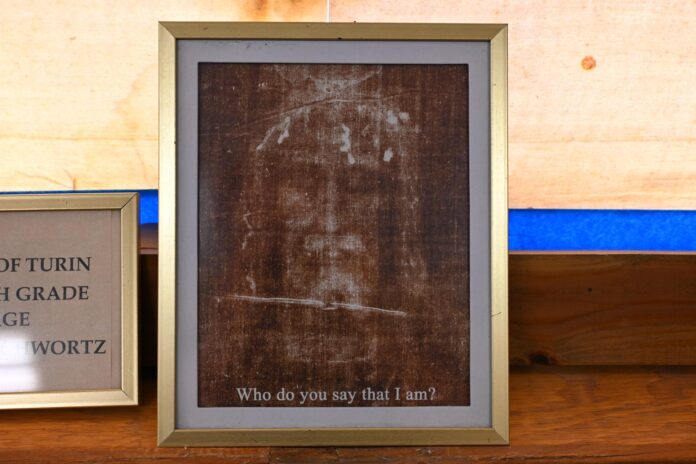
Inside the museum, a 14-foot full-sized, high-resolution photograph of the cloth is the centerpiece of a room filled with historical details and technical analyses.
To the naked eye, the face and body of a man are faintly visible on the Shroud.
A clearer image can be produced by inverting the colors of the image, which a sign instructs visitors on how to do on their smartphone. Then, the face of a man with a mustache, beard, and blood dripping down his forehead becomes clearly visible.
The first inverted image of the Shroud was produced in 1898 by photographer Secondo Pia. His striking image of a man with the same wounds that Jesus endures in the New Testament invigorated public interest in the Shroud.
Scientists and experts began an examination to determine if it was an artistic creation, or if it might be authentic.
Schumacher said that decades of study have made the Shroud “the most studied artifact known to man.” Over the years, the Shroud has been tested in dozens of ways to help determine its composition.
It has been tested for blood type, by x-ray, by different wavelengths of light, and for similarities to other images of Jesus.
A technical abnormality that the Shroud presented first grabbed Schumacher’s attention in 1976 when he was working as a production manager for the company behind the VP-8 Image Analyzer.
The VP-8 was developed to produce three-dimensional renderings of Earth’s surface based on satellite images.
It works by rendering brightness in the original image as height in the produced image. So, for example, the VP-8 renders a checkerboard as a series of hills (the light squares) and valleys (the dark squares).
When Schumacher viewed an image of the Shroud through the VP-8, he found that it produced a three-dimensional image of a human body with the wounds of Christ.
He was shocked.
A three-dimensional rendering like the one from the Shroud, “does not happen with any other image,” Schumacher said.
He said the three-dimensional effect in the VP-8 comes about because of changes in the cellulose structure of the Shroud.
Where the body would have been in the cloth, the changes are more intense and where the body would have been less prominent, the changes are less intense.
While Schumacher said the effect can be intentionally reproduced today, why it appears on the Shroud remains a mystery.
Schumacher said that his surprise at the way the Shroud rendered on the VP-8 did not immediately change his relationship to faith, which was shaky at that time.
“It took years and years before I finally began to comprehend that this image was Jesus,” he said, “And this is what he did for me.”
As Schumacher continued studying the Shroud, he became depressed for a period by ruminating on the details of Jesus’ suffering; his wounds, the blood.
That’s when he reached out to a priest who told him that he shouldn’t just focus on Jesus’ death.
“He looked at me and said, ‘They didn’t find the body; they only found the Shroud. He won over all of this. He rose from the dead,’” Schumacher said.
“Epiphany! It’s about his love for and his victory over sin and death.”
Schumacher said that conversation set him on a journey and that his faith has been growing since.
Schumacher isn’t the only one who has been moved by the Shroud.
He described how a local artist was overwhelmed by an “encounter with Christ,” shortly after the museum opened.
She returned later with a painting of Jesus calming a stormy sea. The museum houses this painting and now sells small prints of it.
Museum volunteer June Gibeau said Schumacher’s passion for the Shroud is evident when he talks to museum visitors.
“I think God is talking to them through Pete, because he does such a good job on his tours,” she said.
Reflecting on the overall meaning of the Shroud, Schumacher said that for him, the biggest question is why Jesus would leave this image of himself behind.
“Why did he leave the first selfie ever?” Schumacher asks. “He did this, as I understand, because that’s his passionate love for us. He wants us to know how much he loves us.”
That same reason is why Schumacher enjoys the museum’s location at the mall.
It serves as a testament to Jesus’ love, even in a secular and commercial context, he said.
“They found the Shroud, but they didn’t find the body,” Schumacher said.
“That’s the joyful news.”
The Shroud Exhibit and Museum is located at 3199 N. White Sands Blvd. and is open Thursday through Tuesday from 1p.m. to 5 p.m. Admission is free, and donations are accepted.