
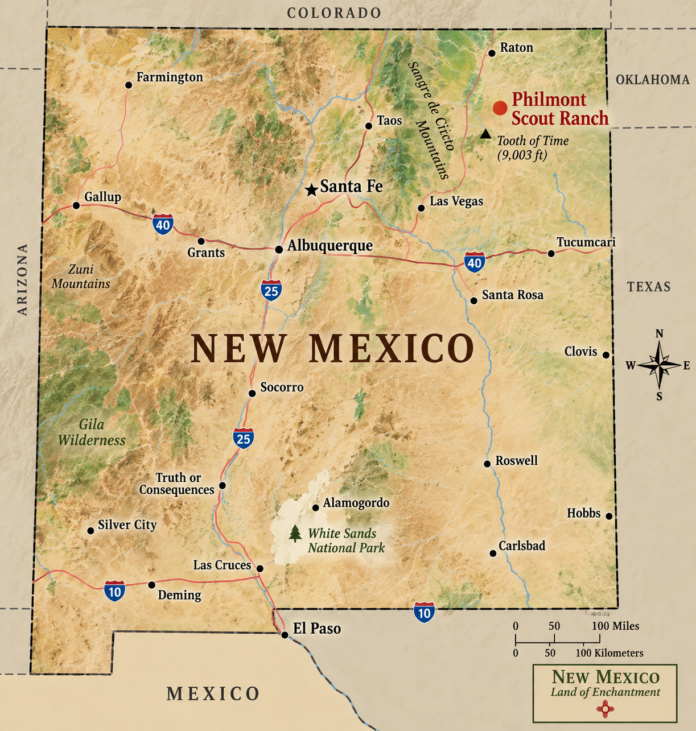
When my mother and I went to a New Mexico Historical Society conference at Philmont Scout Ranch recently, I was surprised when more than a few New Mexicans asked me where Philmont was.
I grew up hearing about the camp; Girl Scouts went to Camp Mary White and Boy Scouts went to Philmont. The Alamogordo Daily News dutifully reported who was going to scout camp each summer.
After World War II, the Baby Boom produced over eight million Scouts and another two million parent volunteers. The great outdoors had not been displaced by television or video games as it eventually would. Scouting fit very comfortably into the postwar ideals of independence, camping, citizenship, practical skills, leadership – all backed up by earning badges!
For American boys, Philmont was the pinnacle adventure of wilderness hiking, camping, and survival skills.
Going there wasn’t simply summer camp. For many, it meant crossing much of the country to reach a place they’d read about and seen in Western movies and on TV.
The Maxwell Land Grant
Long before there was a Philmont Scout Ranch, the area near Cimarron, New Mexico had a remarkable history of its own.
Archaeological sites at Philmont preserve traces of Ancestral Puebloan people called the Ponil People.
Centuries later, the Jicarilla Apache made this meeting place of mountains and plains part of their homeland, hunting bison on the grasslands while also hunting, gathering and farming in the mountain country.
Moache Utes also inhabited the region, and Comanche, Kiowa and Cheyenne hunters moved through the surrounding country. The landscape that would become Philmont was neither empty nor waiting to be discovered when Mexican officials created the Beaubien-Miranda Land Grant in what is now northeastern New Mexico and southern Colorado. Carlos Beaubien and Guadalupe Miranda owned this property seven years before New Mexico became a part of the United States.
Lucien B. Maxwell married Beaubien’s daughter, Luz, acquired interests in the property, and eventually became its principal owner. In time the roughly 1.7-million-acre holding became better known simply as the Maxwell Land Grant.
In 1848, Maxwell established a settlement at Rayado, on land that is now part of Philmont. His friend Kit Carson joined the settlement shortly afterward.
Rayado’s position near a branch of the Santa Fe Trail brought travelers, traders, soldiers and settlers through the country.
Maxwell moved north to Cimarron in 1857. Then gold was discovered around Baldy Mountain in the 1860s, bringing miners and prospectors into the mountains.
In 1870, Maxwell sold the enormous grant to British investors backed by Dutch capital.
What followed was anything but peaceful. Disputes among land companies, settlers, squatters, politicians and courts helped produce the bitter Colfax County War; 200 people were killed.
Eventually the great Maxwell estate was broken into smaller ranches and properties.
Decades later, an Oklahoma oilman began buying some of those pieces. His name was Waite Phillips.
The Man Who Bought a Mountain
Waite Phillips was born in Iowa in 1883, one of 10 children and the identical twin of his brother named Wiate — their parents transposed the a and i in their names.
At 16, the twins left home seeking adventure in the West and took jobs along the way. Their adventure ended tragically in 1902, when Wiate died of sepsis from a ruptured appendix in Spokane.
Waite accompanied his twin brother’s coffin home by train.
Waite later followed his older brothers, Frank and L. E. Phillips, into the Oklahoma oil business. His brothers founded Phillips Petroleum, but Waite established his own company in 1914. He built an integrated operation of oil wells, refineries, railroad tank cars and filling stations before selling the business in 1925 for $25 million, about $478 million in today’s money.
Waite decided to become a rancher and he and his wife, Genevieve, began assembling their New Mexico ranch from pieces of the former Maxwell Land Grant.
By 1932 their holdings had grown to approximately 300,000 acres.
They called it Philmont—”Phil” for Phillips and “mont” from monte, mountain.
It was not simply a wealthy man’s vacation property. Philmont was a working ranch populated by cattle, sheep, goats, horses, polo ponies and bison.
In 1927, the Phillips family completed their magnificent New Mexico home, Villa Philmonte, with guest quarters, staff buildings, a greenhouse, garage and caretaker’s cottage. Phillips and his wife held court with the rich and famous, politicians, artists, writers, and other business tycoons of the day on their ranch.
Before Waite grew bored with the cowboy life and became a real estate developer in Los Angeles, he decided to give half of his wealth away each year.

A Very Large Good Turn
In 1938, Phillips offered the Boy Scouts of America 35,857 acres of his ranch and $50,000 to develop a camp. The Scouts accepted. The new property was called Philturn Rocky Mountain Scout Camp—”Phil” for Phillips and “turn” for the Scout admonition to do a good turn (deed) daily.
The first season opened in 1939. The fee was one dollar a week. That first summer, 196 Scouts from Texas, Kansas, Louisiana and Oklahoma came to the mountains of northern New Mexico.
Phillips watched his experiment. He apparently liked what he saw.
In 1941, Waite and Genevieve made an extraordinary second gift: more than 91,000 additional acres, including Villa Philmonte, ranch headquarters, mountain lodges and livestock—cattle, sheep, goats, horses and bison.
The Scouts now controlled approximately 127,000 acres, but with stipulations: the Phillip’s family could visit whenever they wanted, the camp must remain a working ranch, and his horse, Gus, would live out his days on the grounds.
Phillips also understood something every nonprofit eventually learns: being given a magnificent property and being able to afford a magnificent property are two entirely different matters.
So he gave the Scouts an income-producing asset as well—the 23-story Philtower office building in Tulsa. Its income could help support the ranch.
It was philanthropy with a businessman’s fingerprints all over it.

It Was Still a Ranch
Something important can be lost when Philmont is described merely as a Boy Scout camp. It remained a working ranch.
Horses, cattle and ranching continued alongside the Scout programs.
The bison became part of that heritage as well, and Philmont has documented that today’s herd descends from animals Phillips began collecting during the 1930s.
The Phillips family did not simply hand over the keys and disappear, either.
Successive generations remained connected with Philmont.
And then there was Gus.
Gus was Waite Phillips’s favorite horse.
When Phillips gave the ranch away, Gus was to remain there and was not to be ridden by anyone else.
The Scouts
By 1951, annual attendance at Philmont had grown to more than 5,200, assisted by the establishment of the national training center the previous year.
It is difficult now to appreciate what such a journey could mean to a boy in the early 1950s. Television was only beginning to enter American homes. The Interstate Highway System did not yet exist. Commercial jet travel was still in the future.
Much of what eastern children knew about the American West came from books, movies and radio. Cowboys. Indians. Cattle drives. Mountains. Great empty spaces to hike and camp within.
Boys discovered that the West was real and so were the horses, the cowboys, the natives, and so was New Mexico.
The camp’s landscape contains much of the history of northeastern New Mexico: Natives, Mexican land grants, the Santa Fe Trail, Lucien Maxwell and Kit Carson, miners and cattlemen, the Colfax County War, great ranches, Waite Phillips and finally generations of Scouts.
Philmont continued to expand after Phillips’s original gifts. In 1963, the Scouts purchased another 10,098 acres, including the historic Baldy Mountain mining country—bringing still more of the old Maxwell Land Grant into Philmont.
“No Child Left Inside”
In 2007, members of Congress introduced legislation called the No Child Left Inside Act, a play on No Child Left Behind. Its purpose was to encourage environmental education, teacher training and hands-on outdoor experiences for children.
The House passed a version in 2008, although it did not become law as a stand-alone act. Some of its ideas later appeared in the Every Student Succeeds Act of 2015, which permitted federal education funding to support environmental literacy and outdoor learning.
But Philmont had already been conducting its own version of that experiment since 1939. The ranch gave young people mountains instead of walls.
It let them walk through forests instead of merely reading about them. It encouraged them to encounter wildlife, weather, distance, exhaustion and darkness.
The lessons lasted longer than the trip.
A Ranch the Size of a Kingdom
Today, Philmont stretches across 140,000 acres – around 220 square miles. Elevations range from roughly 6,500 feet to 12,441 feet, and hundreds of miles of trails cross the ranch. More than a million Scouts, Venturers and leaders have participated in Philmont programs since 1939.
In summer the camp becomes something resembling a temporary city scattered across the wilderness.
More than 20,000 Scouts may arrive during a typical summer, while more than 1,200 seasonal employees work in backcountry camps, ranch operations, museums, food service, conservation, maintenance and guest services.
Yet many visitors don’t experience Philmont as an institution. They experience it on foot, shouldering packs, disappearing into the backcountry and discovering precisely how heavy everything they considered absolutely essential becomes after carrying it uphill for several miles.
That may be one of Philmont’s more enduring educational techniques.

Philmont After the Crisis
The more recent history of Scouts cannot simply be skipped. The Boy Scouts of America endured devastating sexual-abuse scandals involving thousands of survivors and subsequently entered bankruptcy.
Public trust in the organization was badly damaged. The organization emerged from bankruptcy, underwent significant changes and in 2025 became Scouting America.
Philmont inevitably carries part of that history because it belongs to the organization. Posters around the camp encourage reporting illicit behaviors, staying in groups, and social media guidelines.
2019 and 2020 became the breaking point years for the BSA;. they lost one of their largest institutional partners when the Church of Jesus Christ of Latter-day Saints ended their Scouting program.
At the same time, thousands of men were coming forward with allegations of childhood sexual abuse dating across generations of Scouting.
Facing enormous potential liabilities, the Boy Scouts of America filed for bankruptcy.
Then the COVID pandemic arrived, camps closed and troop activities ended.
It was a perfect storm – more of a collision than a single breaking point.
Philmont decided to reinvent itself; its current efforts are to attract not only Scouts, but also families, conferences, retreats, educational groups, history groups, reunions and weddings. It is part of adapting a spectacular property built around a huge 20th-century youth movement to a very different 21st-century world.
I discovered that other Philmont myself when I attended a history conference there.
Attendees carried handfuls of books around the campus. Other visitors arrived with backpacks ready for long hikes.
Families gathered to share large tents, ride horses, and eat BBQ in the huge mess hall. One carried a wedding dress.
This broader use of the beautiful place at the edge of the prairie and up the Sangre de Cristo mountains will hopefully decide Philmont’s future. Waite Phillips did not merely give the Scouts a summer camp.
He gave them a place.
And places can acquire new purposes without surrendering their old ones.
Philmont still offers what it offered generations ago: a chance to go outdoors where wild turkeys cross your trail, deer appear at the edge of the trees, and bison still roam the ranch.