
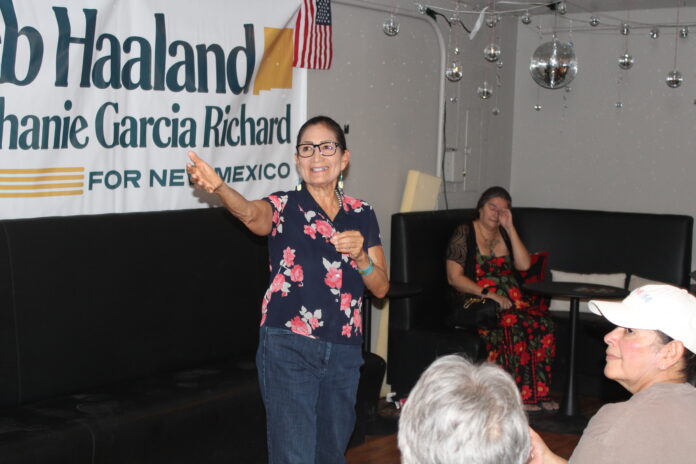
There will be no debate between Democrat Deb Haaland and Republican Gregg Hull as the two square off in the race for New Mexico governor.
That means the Sept. 24 debate between their running mates, Democrat Stephanie Garcia Richard and Republican David Gallegos, will be the only debate related to the gubernatorial election decided Nov. 3.
In response to Haaland and Hull’s apparent inability to schedule a debate, Republicans in the New Mexico Legislature said they are drafting a bill known as the “No Ducking Debate Rule,” which would require at least one debate between future gubernatorial candidates. The proposal was announced Monday, Sept. 28 in a joint news release from the New Mexico House and Senate Republican and would include yet-undetermined financial penalties for noncompliance.
State Sen. Nicole Tobiassen, R-Albuquerque, and state Rep. Gail Armstrong, R-Magdalena, are writing the proposal.
The release did not specify the penalties or address minor-party candidates, but Brandon Harris, communications director for New Mexico Senate Republicans, told the Roswell Tribune in an email Monday the penalties would likely target campaigns, not individual candidates.
“New Mexicans deserve to see both candidates for governor on the same stage, answering the same questions before they vote,” Tobiassen said in the release.
Republicans announced the proposal after Haaland’s campaign said she would not face Hull in an Oct. 8 debate on KOB-TV or in any other debate.
Haaland, a former U.S. interior secretary and U.S. representative for New Mexico, rejected the claim that she declined to debate Hull, former mayor of Rio Rancho. At a Sept. 18 campaign stop in Carlsbad, she said her team proposed eight dates for debates to Hull’s campaign, which rejected all of them.
“My opponent said he would debate anywhere anytime, but it turns out that none of the eight debates that we put forward he wants to do,” Haaland said.
In a Facebook post last week, the Hull campaign said it agreed to debates on multiple occasions but Haaland wanted only debate dates that came after Oct. 6 when early voting begins. Haaland’s campaign did not respond to requests for comment Monday.
The dispute took center stage during the debate between State Sen. Gallegos (R-41) and Garcia Richard, who is currently the New Mexico commissioner of public lands but is term limited and will leave that office in 2027.
Gallegos condemned Haaland’s decision, saying that refusing to debate deprives voters of the chance to assess the candidates.
Garcia Richard defended Haaland, noting Haaland’s background as a former political organizer, congresswoman and U.S. interior secretary shows she is not afraid to debate, and that Haaland was traveling the state talking with voters.
The 68-minute debate was sponsored by the Albuquerque Journal, KKOB and KOAT, the candidates fielded questions on a range of issues. Here’s what the lieutenant governor candidates discussed.
Cost of living
Raising the minimum wage and expanding tax breaks, such as the child tax credit, would be priorities for her and Haaland, Garcia Richard said. She also spoke of creating a public option in the state for health insurance and building new housing.
Garcia Richard also accused Gallegos of being “a rubber stamp” for President Donald Trump’s tariffs and war in Iran.
Gallegos responded that he does not advise Trump and is focused on cutting regulations to lower the cost of doing business.
Data centers
Asked whether and how the state should regulate data centers, Gallegos said he would like small nuclear reactors to power them and treated brackish water to cool them.
Garcia Richard said Haaland will impose a temporary moratorium on data center construction by executive order. The order would remain in place until the Legislature sets “guardrails,” regulations to protect the state’s water supply and shield consumers from spikes in electricity prices.
Haaland’s support of the moratorium was announced during a press conference she held Thursday, Sept. 17 in Albuquerque where she said the move initially proposed by Democratic state lawmakers was intended to address widespread concerns as the facilities are proposed and build throughout New Mexico.
Medicaid, food assistance and health care
The candidates disagreed over how to handle federal cuts to Medicaid and the Supplemental Nutrition Assistance Program. The cuts stem from a tax bill known by supporters as “the One Big Beautiful Bill Act,” which Trump signed into law July 4, 2025.
Gallegos argued the way to blunt the effects of the cuts is to transition more New Mexicans off the programs.
“I believe we need to find ways to make this more of a hand up and not a hand out, and be able to get our people in New Mexico strong enough that they can stand on their own,” Gallegos said.
Garcia Richard, who said she was once on Medicaid and SNAP, disagreed with Gallegos’ characterization and blamed the federal government and Trump administration for the cut.
“I will put the blame where the blame should land, with the Big Beautiful Bill making cuts to New Mexicans’ very crucial health care coverage,” she said.
Public safety and immigration enforcement
Gallegos said state and local agencies should work with federal agencies, such as Immigration and Customs Enforcement, or ICE, to remove people with undocumented immigration status who have criminal histories.
He also said the state should revamp its pretrial detention system so more criminal suspects can be held without bond pending trial.
“I think we need to keep them incarcerated, figure out the problem, whether it’s behavioral health or whatever is causing it,” he said.
Without offering specifics, Garcia Richard said that she and Haaland have a plan to work with law enforcement to get them with the needed resources “to get violent criminals and illegal drugs off our streets.”
Garcia Richard added that mental health professionals, not police, should handle incidents involving behavioral health crises when possible.
In contrast to Gallegos, Garcia Richard expressed opposition to assisting ICE with immigration enforcement, especially in public places such as schools.
Child welfare
One thing the candidates agreed on was the need to overhaul the New Mexico Children, Youth and Families Department, known as CYFD. Garcia Richard said an independent commission of experts should lead CYFD instead of a Cabinet secretary. Gallegos said CYFD’s main priority should be children’s well-being rather than the needs of the parents.