
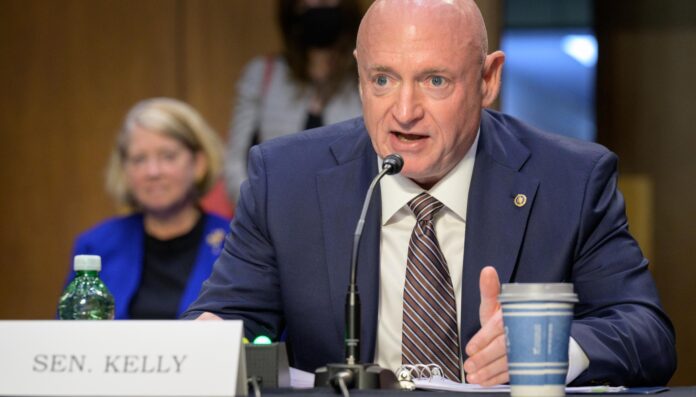
Senator Mark Kelly is up front about his ambitions in space.
He set out as a teenager to be the first person who walked on Mars, and he says today that he literally failed at that mission.
But now, weeks away from his induction to the International Space Hall of Fame, Kelly said it was worthwhile to dream big dreams.
“What’s really interesting about that is you have a goal, but do you really think you’re going to achieve it?” asked Kelly, who spoke with the Alamogordo News over a Zoom connection. “I remember being that age and thinking, ‘OK, this is a good thing to try to do, but I’m probably not going to be successful.’ But here’s the thing for anybody out there thinking in these terms: You’re not going to be successful if you don’t try.”
Kelly and his identical twin brother Scott Kelly will be part of the 2026 induction class for the International Space Hall of Fame, located in Alamogordo, on October 3.

The brothers had previously been inducted to the United States Astronaut Hall of Fame, housed at the Kennedy Space Center Visitor Center, but as part of different classes. Scott Kelly was inducted in 2020, and Mark Kelly followed his younger twin with a 2023 induction.
This time, they’re going in together, but neither brother will be in attendance.
“I wanted to be there, but I’ve got a little bit on my plate right now,” said Mark Kelly, who has served as one of Arizona’s two Senators since a 2020 special election.
Mark Kelly, when asked about his interest in space, says that it’s been a part of his life as long as he can remember.
The twin brothers tuned in to watch Neil Armstrong step on the moon in July of 1969, but Senator Kelly said only one of them retains the memory.
“My brother remembers Neil going down the ladder and stepping foot on the moon and I do not remember that in real time,” he said. “My mom said I fell asleep on the floor. It was late. We were in kindergarten. And it was like 9:00 or 10:00 p.m. I must have had a busy day.”
Their imagination was stoked early, but Mark Kelly said that space didn’t become an obsession until a little bit later in their lives.
He said he was much more cognizant of what was happening with Apollo 15, 16 and 17; Kelly studied the missions leading up to launch, and he began looking at the backgrounds of the people who became astronauts. He noticed one thing they all had in common: They were Navy and Air Force test pilots.
“That’s what got me interested in carrier aviation, becoming a test pilot, eventually becoming an astronaut,” he said.
“I had a goal pretty early in life – like by the time I was in high school – my goal was to be the first person to walk on the planet Mars. And I failed.”
Kelly deployed twice to the Persian Gulf during Operation Desert Storm, and he attended US Naval Test Pilot School from 1993 to 1994. He also earned an advanced degree in aeronautical engineering before he started his astronaut career in earnest.
Kelly, whose NASA bio states that he has logged more than 5,000 hours in more than 50 different aircraft, said that aeronautical engineering is a popular degree for astronauts because of the challenges involved in bringing the space shuttle back to Earth.
“The Space Shuttle is a complicated flying machine,” he said of the retired ship that took him to space four times. “It is a rocket ship, it’s a spaceship, and it is an airplane. It’s a pretty good rocket ship. It is the best spaceship ever built by far. And it is a crappy airplane.
“The thing about when you’re starting out at Mach 25 and then you have to land on a runway, you’re flying in hypersonic speeds, supersonic, transonic, subsonic, and then landing speed. It all has to work. By the way, you’re doing it as a glider coming back.”
Kelly said he can recall the first flight of the space shuttle, which occurred in April of 1981. He was fascinated by the crew of John W Young and Robert L Crippen and the risks they assumed in the interest of traveling to space aboard the shuttle.
“This was not like anything we ever designed before. A winged vehicle, flying on the side of a rocket,” he said of the space shuttle. “I remember just thinking, man, the odds of these guys getting back safely, to me as an 11th grader growing up in New Jersey, I thought was extremely low. So I was like glued to that mission. It was either the launch or the landing, but I remember like skipping school and watching it in in my basement.”
Kelly went up into space for the first time in 2001, and he piloted Endeavour on December 5, 2001 to deliver three tons of equipment to the International Space Station. That mission was NASA’s first flight following the terrorist attacks of September 11, 2001.
Five years later, Kelly participated in NASA’s second Return to Flight mission following the loss of space shuttle Columbia in February of 2003.
“We did a lot of testing of inspection capability with a big boom system,” he said of that flight. “Three of the astronauts aboard Columbia were my astronaut classmates. I was also the person that recovered their bodies from East Texas. So now we’re back in space. We think we solved the problems from the Columbia tragedy, but you’re not quite sure.”
Kelly’s fourth space flight – his final flight and also the final flight of Endeavour – is probably the one that he remembers the most. That mission, which launched in May of 2011, coincided with personal tragedy in his life. Kelly’s wife, former Congresswoman Gabrielle Giffords, was shot in the head during an assassination attempt that January.
So while Kelly was in space, millions of miles away, his thoughts were also at home.
“I remember a lot of that flight,” he said. “It was a historic flight. We delivered the alpha magnetic spectrometer which is a cosmic particle detector looking for antimatter in the universe. That was the most expensive payload ever flown on the space shuttle. It was a $2 billion dollar cosmic particle detector so you want to make sure the mission goes right.
“Gabby was in the hospital during the time and I was also the responsible individual as the commander of the mission, You’re the one who is trying to make sure everything goes right, you don’t kill anybody, don’t break anything and get everything accomplished.”
When he came home from his final mission, Kelly retired from NASA and ultimately embarked on his adventure in politics. He said he probably would’ve stayed with NASA longer in a different world where Giffords was healthy and resuming her career in Congress.
Kelly, who identifies as a lifelong public servant, relished the opportunity to make a difference in another arena. He said he may have participated in longer duration missions as an astronaut if he had stayed with NASA, but ultimately he doesn’t feel conflicted.
“I’ve always been a public servant from the time I was in high school. I drove an ambulance in high school and little bit in college,” he said. “I went into the Navy when I was 22 to fly airplanes. I was in the Navy for 25 years. I was at NASA for 15 years, overlapped there.
“And then this is a different kind of public service, trying to solve some hard problems in a time when technology is changing really fast. I’m one of the few people here in the Senate or the House for that matter that have a background in engineering.”
Kelly, when asked about his early ambitions to travel to Mars, delivers an interesting distinction.
He said that he’s not sure whether he’ll see somebody travel to Mars during his lifetime, but he believes the first person to walk on Mars is already alive today.
With that said, he wants people to look at Mars realistically. Earth is still an island in our solar system, and it’s not realistic to think of our neighbor as an alternative.
“Mars is a shit planet,” he said. “If people think there’s some kind of an escape hatch here, and we’re going to just go somewhere else, you’re not paying attention. You think we’ve got a problem with carbon in our atmosphere? It’s heating up the planet. That is legitimate science. It’s going to get harder to live here. The amount of carbon in the atmosphere on Earth is less than 1%. On Mars, it’s over 98%. It’s not a realistic thing to think we move people to Mars to save humanity. We need to focus on Earth.”
Mark and Scott Kelly will be inducted to the International Space Hall of Fame on October 3. For more information about the induction class, visit the New Mexico Museum of Space History’s website.