
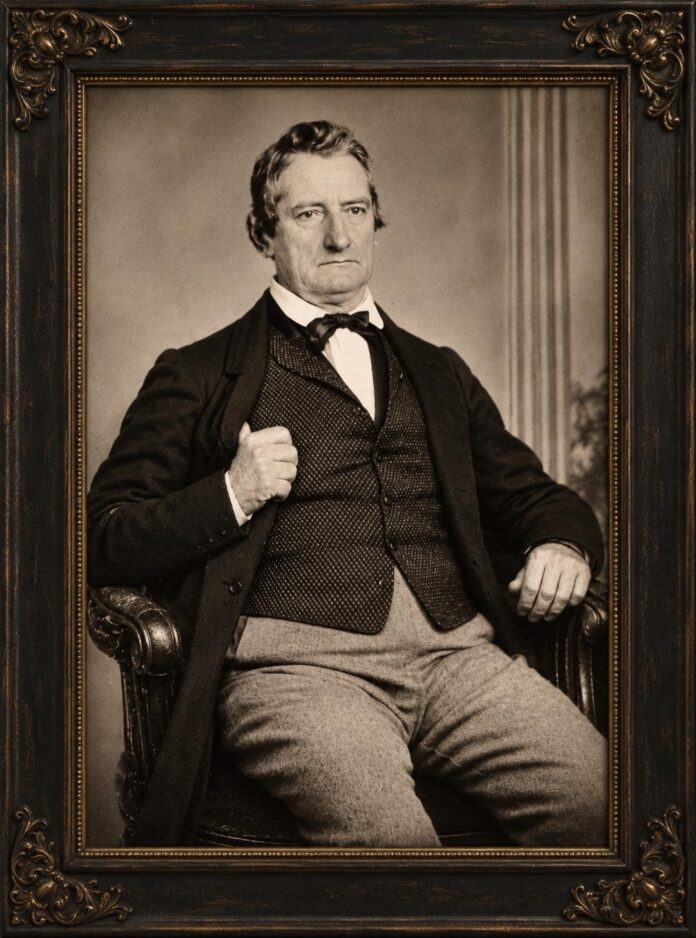
Candace McDonald
Daniel Davis’s son John, my fifth great-uncle, died at the Alamo. Another son, Zachariah, and his wife Rosanna burned their ranch buildings and helped lead the widows and families fleeing Gonzales ahead of Santa Anna’s advancing army.
Rosanna’s grandchildren recalled her saying that the hardest part of the retreat wasn’t watching their property go up in flames. It was comforting the newly widowed women and fatherless children mourning those killed at the Alamo.
Meanwhile, Daniel and another son, George Washington Davis, were busy helping burn Gonzales before escaping with provisions and their fiddles.
My ancestors were willing to sacrifice their homes, possessions, and their lives for Texas independence. But by God, they weren’t leaving without their fiddles. Apparently, there was no sense enduring a revolution without music.
The mud, hunger, and exhaustion of the Runaway Scrape made Texas independence seem increasingly hopeless. Sam Houston’s men were spoiling for a fight, and some threatened mutiny over his continued retreat. But Houston knew his ragtag army needed reinforcements, supplies, rest, and, above all, an advantage against a larger Mexican force.
A captured Mexican courier carried valuable intelligence about Santa Anna’s movements toward Buffalo Bayou and the San Jacinto River. Santa Anna, meanwhile, had raced eastward ahead of much of his army, apparently confident he could crush the rebellion without waiting for all his forces to assemble.
The self-styled Napoleon of the West expected another easy victory and the glory that accompanied it. His officers, hardly inclined to disagree with him, assured him the Texans were running because they knew they couldn’t beat him.
Come to the Bower
Houston’s troops crossed Buffalo Bayou and established camp in a wooded area behind a rise near the San Jacinto River, concealed from the Mexican army.
Santa Anna’s soldiers were exhausted from forced marches through muddy terrain. Some had spent much of the previous night constructing makeshift breastwork defenses, while General Martín Perfecto de Cos arrived with reinforcements worn out from a six-day march. Santa Anna expected an attack the following morning.
But the Texans didn’t charge at dawn. At noon, they still hadn’t charged. Having watched Houston retreat for weeks, Santa Anna had little reason to believe the rebels were suddenly developing an appetite for battle. The weary soldiers rested, ate, unsaddled their horses and let them graze. They were an army badly in need of a nap.
Here, Davis family lore introduces an unusual contribution to the Texas Revolution.
According to the family account, Houston wanted to move his volunteers closer to the Mexican camp without arousing suspicion. Daniel and George Washington Davis were asked to provide music while the men practiced marching.
In a clearing visible to the Mexicans but beyond gunshot range, Houston loudly ordered the two fiddlers to strike up a march.
There was a problem: Neither fiddler knew a march, and the revolutionaries weren’t particularly accomplished at marching either.
After a hurried consultation, father and son settled on “Will You Come to the Bower,” a popular love song hardly suited to accompanying an army into battle, but they sped it up and turned into a dirge with a bit of a stomping beat.
The song’s romantic invitation to a leafy bower also carried associations with Irish nationalism and the struggle for independence from Britain. Whether the Davis men appreciated that symbolism is another matter. They needed a tune, and this was one they knew.
The Texans began exhibiting their marching skills, stumbling and footslogging about with considerably more enthusiasm than precision. From the Mexican camp, they may have appeared drunk. And, alcohol may have been involved.
According to family tradition, the performance helped disguise Houston’s preparations as the hiding Texas fighters advanced through the tall grass.
It must have been quite a spectacle: a ragged army bumping into one another, two fiddlers scraping away at the same tune, and Houston reportedly shouting orders with an impressive amount of profanity.
The marchers slowly approached the Mexican position while the Davis men continued playing. The soldados rolled over and continued their naps.
Then, shortly before 4:00 p.m. on April 21, 1836, Houston gave the signal. Two cannons named The Twin Sisters fired. Texan artillery opened fire, and the troops charged, now close enough to catch the sleeping army completely unprepared.
The Mexican army, caught unprepared, the sun in its eyes, cannon and gun smoke clouding the air, horses unsaddled, collapsed in a battle lasting just 18 minutes.
The Davis family maintained that Daniel and George never fired a shot at San Jacinto. Their contribution was musical.
George later applied for a veteran’s land grant. Daniel reportedly declined, explaining that all he had done was fiddle around.
That is a rather modest assessment of one’s contribution to a revolution.
Emily West: The Yellow Rose of Texas
Another enduring San Jacinto legend concerns Emily West, a free Black woman — a yellow rose, as mixed race women were called. She was from New York and employed by Col. James Morgan. Captured during the Mexican advance through East Texas, West supposedly attracted Santa Anna’s attention.
According to the story, she plied the general with alcohol and entertained him in his tent on the afternoon of the battle, distracting him while Houston’s army prepared for attack. She later became associated with the song, The Yellow Rose of Texas.
The story traces largely to gossip recorded by English traveler William Bollaert several years after the battle. What is documented of the perfectly good scandal is that Emily survived San Jacinto and obtained a Republic of Texas passport in 1837 to return to New York.
Whether Emily West or the Davis fiddlers actually helped defeat the Mexican army, or merely became subjects of stories too entertaining to abandon, Texans have never been particularly eager to let facts interfere with a good legend.
Santa Anna Captured
The Texans showed little mercy during the rout and its aftermath. Hundreds of Mexican soldiers were killed, while Texan losses were remarkably small.
Santa Anna escaped the battlefield disguised in ordinary clothing but was captured the following day. According to the familiar account, other prisoners betrayed his identity by accidentally addressing him as “General.”
Houston’s soldiers wanted him hanged. Houston recognized that the captive president was worth considerably more alive.
Santa Anna subsequently signed the Treaties of Velasco, agreeing to withdraw Mexican forces and promising to work toward recognition of Texas independence. Mexico’s government later rejected the agreements, and the dispute was far from settled.
For Santa Anna, humiliation at San Jacinto was merely another chapter in an astonishing political career.
He would return to power repeatedly, lose his leg fighting in The Pastry War with the French, spend time in exile on Staten Island, New York, helping invent chewing gum, and preside over Mexico losing half of its territory to the United States.
Daniel’s Last Adventure
Daniel Davis apparently had little interest in settling into a peaceful old age.
Family tradition places him in the disastrous Mier Expedition of 1842, when he was approximately 60 years old.
Six years after Texas declared independence, Mexico still refused to recognize the republic. Following renewed Mexican raids into Texas, President Houston sent General Alexander Somervell toward the Rio Grande on a retaliatory campaign.
When Somervell ordered his troops home, some 300 dissatisfied Texans refused. They crossed into Mexico in search of revenge, glory, and whatever livestock wasn’t nailed down.
Unfortunately, Mexico was considerably better prepared to defend its territory than the Texans were to invade it.
At Mier, they encountered a much larger Mexican force under General Pedro de Ampudia. After fierce fighting in December 1842, the Texans flew the white flag.
After an attempted escape, Santa Anna ordered another brutal punishment: 176 prisoners drew beans from a jar containing 159 white beans and 17 black ones. Those drawing black beans were executed by firing squad.
The survivors were marched 1,000 miles into Mexico and imprisoned at the formidable Perote fortress near Veracruz. Guards shackled prisoners together in pairs with heavy iron chains and forced them to haul heavy loads of sandstone, lime, and rock.
The prison sat on the high elevation on the side of a volcano and the thick stone cells were bitterly cold and damp. Small portions of beans, rice, potatoes, and bread left the prisoners malnourished and physically exhausted. Poor sanitation, typhus, dysentery, and fever killed men in droves.
Sixteen prisoners escaped through a tunnel under the moat in July 1843; the remaining 105 captives were released in September 1844.
Family tradition claims Daniel drew a white bean, survived imprisonment at Perote, and eventually returned to Texas. His health suffered from the harsh conditions in the prison and he died less than two years after returning.
Some people just simply don’t know when to retire.
When Daniel was born, he was a British citizen; a year later the Treaty of Versailles was signed and he became a U.S. citizen. George Washington had not yet become president and Texas still belonged to Spain.
By the time Daniel died, Texas had passed through Mexican rule, revolution, became the Republic of Texas, and was admitted to the United States. He had held five citizenships.
His final will and testament, reportedly signed with an X because he could not write, survives among early Gonzales County probate records. It distributed land and other property, including an enslaved person — a reminder that frontier prosperity in family histories were sometimes also bound to slavery.
Daniel and his wife Elizabeth were originally buried in Gonzales, but their remains were relocated when the old cemetery site was repurposed to become an Episcopal Church. Their final resting place is believed to be an unmarked common burial area in the newer city cemetery.
Their descendants inherited a remarkable collection of stories: burning towns, fleeing widows, fiddling soldiers, Mexican prisons, and a patriarch who apparently considered turning 60 as an excellent opportunity for another adventure.
Many accounts are documented. Others have been polished by nearly two centuries of retelling.
And that is the trouble with family history. Every generation adds a little something, forgets a few inconvenient details, and can occasionally promote a perfectly ordinary person into a hero.
Still, I find the image of my ancestor Daniel and George Washington Davis standing near the battlefield at San Jacinto, sawing away on fiddles while a revolution unfolded around them, rather irresistible.
Whether they actually played that day remains uncertain. But if they did, they may have been among the few in Texas history who could claim to have fought a battle without firing a shot.
Not a bad accomplishment for men who couldn’t sign their own names.
And, as my father always said, “If it isn’t true, it should be.”
Epilogue: Santa Anna’s Leg
General Antonio López de Santa Anna lost battles, lost the presidency, lost Texas, and lost his left leg. Unlike himself, however, his missing limb received a magnificent funeral.
Two years after his humiliating defeat at San Jacinto, Santa Anna attempted to restore his reputation by defending Veracruz against the French during the so-called Pastry War. Struck by cannon fire, he lost his left leg below the knee.
Never one to waste a political opportunity, Santa Anna transported his leg to Mexico City for a state funeral, complete with military procession, cannon salutes, speeches, and an elaborate monument.
Unfortunately, the leg’s political fortunes proved no more stable than its owner’s. When Santa Anna fell from dictatorial power, an angry mob dug it up and dragged it through the streets.
Three years later, during the Mexican-American War, Santa Anna narrowly escaped American troops at Cerro Gordo, reportedly abandoning his roast-chicken lunch and artificial leg in his haste.
Illinois soldiers ate his chicken and kept the prosthesis, which eventually found its way to the Illinois State Military Museum.
For a man who repeatedly struggled to maintain his political footing, Santa Anna had remarkably little luck. He lost his real leg to the French, his buried leg to his own countrymen, and his replacement to the Americans. Mexico has asked for his prosthesis back for their own museum, but as the lawyers say – “They don’t have a leg to stand on!”