More nuclear waste from Idaho is being disposed of near Carlsbad despite pressure to increase shipments from within New Mexico.
At WIPP, the Energy Department disposes of transuranic (TRU) nuclear waste, which is clothing materials, equipment and other debris irradiated during nuclear activities.
The waste is buried at WIPP, about 30 miles east of Carlsbad, in a salt deposit about 2,000 feet underground. The salt gradually collapses on the waste, burying the refuse and blocking radiation from escaping.
Since WIPP opened in 1990, about 53% of the waste came from Idaho National Laboratory – 7,908 of the 14,970 shipments received during the facility’s lifetime, according to federal records.
The high ratio is due to a 1995 settlement agreement between the energy department and the state of Idaho requiring at least 55% of WIPP’s shipment capacity be reserved for Idaho shipments.
That practice is likely to continue, officials said in a Nov. 10 news release as the agency touted 64% of WIPP shipments from Idaho between Fiscal Years 2024 and 2026. Federal fiscal years run from Oct. 1 to Sept. 30 and are named for the calendar year they end in.
FY 2025 saw 68% of waste sent from Idaho. In FY 2024, about 74% came from that lab.
Officials gave no estimate on how much longer the Idaho lab would send waste to WIPP, contending that the timeline depended on the production of waste and the rate of its processing for disposal.
But the progress at Idaho comes as the Department of Energy faces heavy scrutiny from New Mexico officials who say the feds have failed to prioritize in-state waste, specifically from Los Alamos National Laboratory, despite a clause in WIPP’s state permit requiring such a priority.
The 10-year permit was renewed in 2023 and contained language requiring that the repository focus on Los Alamos waste and so-called “legacy waste” left over from past nuclear programs such as the Manhattan Project that spurred development of the nation’s first nuclear weapon at the lab in northern New Mexico.
The 82 shipments sent from Los Alamos to WIPP in FY 2026 marked a 91% increase from FY 2025’s total of 43 shipments. Fiscal Year 2024 saw 49 shipments from Los Alamos, and there were 68 shipments from the lab in FY 2023, meaning that year marked a 39% decline.
In FY 2026 a total of 116 shipments came from Los Alamos, records show – about 38% of the 305 shipments sent to the site. In the same fiscal year, 141 shipments or 46% of the total came from Idaho.
Mindy Toothman, deputy manager of the Department of Energy’s Carlsbad Field Office, said during a Nov. 4 town hall meeting that WIPP can accept up to 17 shipments per week but averages 15 and takes in up to five shipments a week from Los Alamos.
That was about six months after New Mexico Environment Department Cabinet Secretary James Kenney voiced dissatisfaction with the federal government’s pace of cleaning up Los Alamos, issuing a proposed modification in April requiring 55% of waste shipments come from Los Alamos by 2027, and 75% starting in 2032.
In a statement announcing the proposal, Kenney said it was aimed at “strengthening the Waste Isolation Pilot Plant’s operating permit to affirm the commitments made to protect the health of communities across the United States, including New Mexicans.”
The modification was still being debated with a final decision on its requirements expected by the end of the year.
Higher-level waste
FY 2026 was also the first year that both higher-level remote-handled waste and lower-level contact-handled waste were both shipped from Idaho to WIPP, which the Department of Energy said was “reflecting continued expansion of shipping capability across the Idaho National Laboratory Site.”
Remote-handled waste carries a higher dose of radiation, 200 millirems or more per hour. It was traditionally handled only via machine due to its higher dose than that of “contact-handled” waste, which contains less than 200 millirems per hour.
Contact-handled waste makes up about 96% of the refuse disposed of at WIPP, read a news release from the Department of Energy.
A standard TV screen emits about one millirem of radiation per hour, according to the Nuclear Regulatory Commission.
Shielded containers approved for use in 2024 allow remote-handled waste to be disposed of in the underground using the same methods as contact-handled waste.
Remaining at Idaho are about 17,000 contact-handled waste containers and about 1,000 remote-handled, read the news release. Another 13,000 containers were identified as in need of future “certification,” a process that will determine their classification and processing needs before shipment to WIPP.
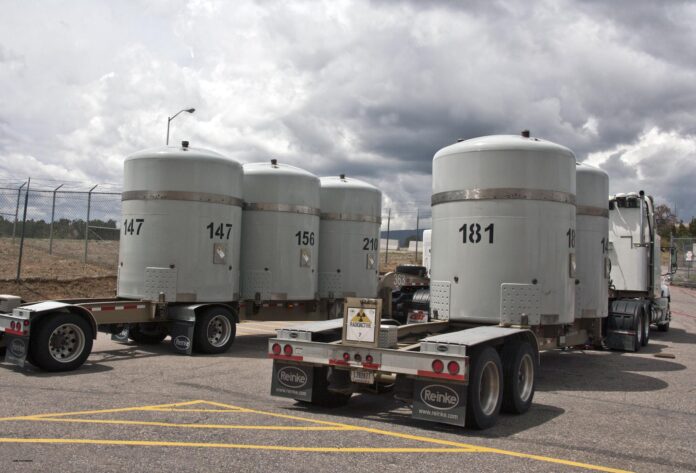
A single waste shipment can carry up to three shipping containers, with each holding up to 14, 55-gallon drums of waste, according to a Department of Energy fact sheet.
And with thousands of containers left at Idaho National Laboratory to be disposed of at WIPP, the progress was touted by Kelly Wooley, senior project director with the Idaho Environmental Coalition – the federal contractor hired to manage the lab’s cleanup operations.
“None of this progress would be possible without the workers in the field, whose safe execution of daily tasks enables us to consistently process, certify and ship thousands of containers each year,” Wooley said. “Their skill and commitment underpin the momentum Idaho continues to demonstrate in meeting cleanup and shipment goals.”
Managing Editor Adrian Hedden can be reached at 575-628-5516, or @AdrianHedden on the social media platform X.