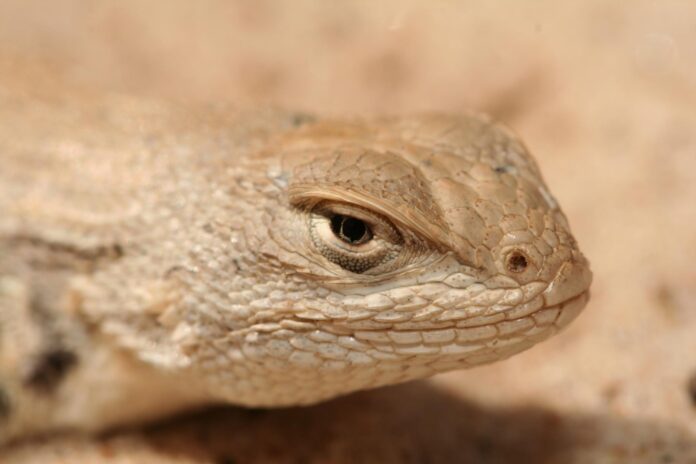
A federal court rescinded protections for an imperiled lizard species that dwells among the sand dunes and oil rigs of the Permian Basin.
The dunes sagebrush lizard lives and breeds throughout southeast New Mexico and West Texas, using the sandy landscape and shinnery oak shrubbery for its habitat.
Expanding oil and gas development in the area, and the mining of sand used in drilling operations were listed as top threats to the species when the U.S. Fish and Wildlife Service listed the lizard as “endangered” on May 20, 2024.
But in a reversal, parent agency the U.S. Department of the Interior on Tuesday, July 21, signed a settlement agreement with the state of Texas rolling back the protections. The settlement was in response to the state’s lawsuit filed Sept. 23, 2024 – about five months after the listing.
Under the Endangered Species Act, “endangered” status means the agency believes extinction is imminent. The designation requires lands be set aside as habitat for such a species to recover, and limits development that could further impact its population.
The lower “threatened” status also restricts development in certain areas and indicates an endangered listing may soon be warranted.
In the settlement filed in U.S. District Court for the Western District of Texas, the federal government and state agreed that the sagebrush lizard’s listing failed to account for ongoing conservation work by federal, state and private entities in both Texas and New Mexico.
The Fish and Wildlife Service’s initial analysis of the lizard’s habitat was “incomplete,” read the settlement, and “potentially inaccurate.”
Within two years of the settlement’s July 21 approval by U.S. District Judge David Counts, the agency intended to begin a one-year study to reanalyze the lizard’s status and could reinstate its endangered listing.
“The Service now believes that it is necessary to reconsider its determination that the dunes sagebrush lizard meets the statutory definition of an endangered species,” the settlement read. “Defendants are aware of ongoing conservation efforts undertaken by federal, state, and private entities for the benefit of the dunes sagebrush lizard that will continue notwithstanding vacatur of the Final Rule.”
The settlement drew outcry from conservation groups that argued it was part of a pattern by the administration of President Donald Trump in curbing environmental protections such as those for endangered species.
Jason Rylander at the Center for Biological Diversity, a national environmental nonprofit, pointed to the February delisting of the lesser prairie chicken, a grouse species native to the plains of eastern New Mexico and West Texas, along with Colorado, Oklahoma and Kansas. That was in response to a lawsuit filed by the state of Texas shortly after the species’ 2022 listing.
And in 2025, the Interior Department announced plans to delist a group of river mussels native to Texas, in response to another lawsuit filed by the state.
Meanwhile, the Center for Biological Diversity filed its own lawsuit in June, arguing the federal government so far failed to set aside habitat lands for the Texas hornshell mussel, which was granted endangered status in 2018.
Rylander said such reductions in species protection occurred without public hearings or input. The Center filed an appeal after it was denied standing in the lesser prairie chicken case, and Rylander said another was being filed for the dunes sagebrush lizard.
“Courts should not wipe endangered wildlife protections from the books without a hearing or ruling,” Rylander said. “The Trump administration and Texas seem to have found a formula for eliminating listing decisions they don’t like. But imperiled species, their habitat and the rule of law itself are the real casualties here.”
Texas Railroad Commissioner Wayne Christian – the three-member railroad commission oversees regulation of the oil and gas industry for the state of Texas – said delisting the lizard was a “significant victory” against “regulatory overreach.”
“The goal was never about protecting wildlife,” Christian said. “It was about using federal bureaucracy as a tool to restrict oil and gas production and undermine American energy independence.”
Managing Editor Adrian Hedden can be reached at 575-628-5516, or @AdrianHedden on the social media platform X.