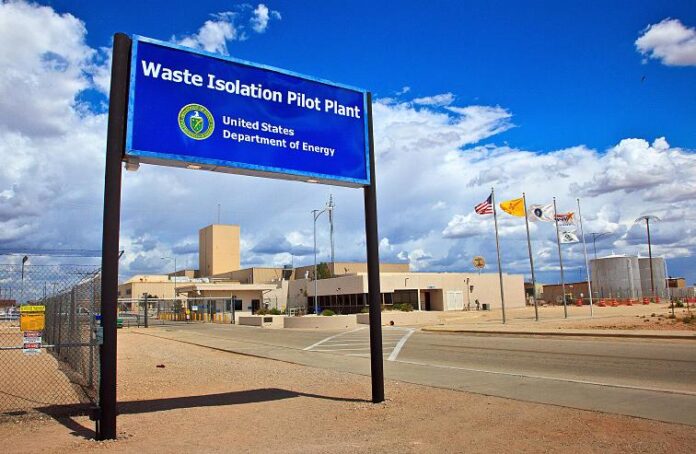
U.S. Sen. Martin Heinrich called for the federal government to investigate an incident officials said posed no danger at a nuclear repository.
The Aug. 19 event saw a hoist in an air intake shaft at the Waste Isolation Pilot Plant fall about 1,600 feet to the bottom of the mine when a rope snapped during a routine test of the lift.
No one was injured and no workers were in the area when the hoist fell, according to a statement from the U.S. Department of Energy.
All work was temporarily paused following the incident, allowing the federal government to “communicate with employees about the event and assess the situation,” read the statement.
“Prior to beginning work on the hoist, barriers were installed to restrict personnel access to the work area,” read the statement, which noted an investigation was underway to find the “root cause” of the incident. “At no time were any employees at risk of injury and all safety controls for the planned work were implemented as required.”
But Heinrich charged that the incident was indicative of a broader problem with the site’s infrastructure.

In an Oct. 6 letter to U.S. Secretary of Energy Chris Wright, Heinrich asked that the department be “proactively engaged as an active participant in the investigation and resolution of this incident.”
“Workers must be kept fully informed of findings and corrective actions, and their safety concerns must be meaningfully addressed, not managed,” the letter read.
Heinrich’s letter was also signed by U.S. Sen. Ben Ray Lujan (D-NM), who is running for a second six-year term in the Nov. 3 midterm election. Lujan’s opponent, Republican Larry Marker of Roswell, earned his place on the ticket as an unopposed write-in candidate in the June 2 primary.
At WIPP, the Department of Energy disposes of transuranic nuclear waste (TRU), which is clothing materials, equipment and other debris irradiated during nuclear activities.
The waste is buried at WIPP in a salt deposit about 2,000 feet underground. The salt gradually collapses on the waste, burying the refuse and blocking radiation from escaping.
The process includes a series of four hoists in the underground that can move people in and out. There is a hoist that also moves mined salt to the surface, the main hoist that also moves waste to the underground and two air intake shafts.
After the incident, which left the lift car and hoist unusable, the emergency egress was shifted to another air shaft known as the “utility shaft,” which WIPP recently installed on the west side of the mine.
There is also an exhaust shaft that does not include a hoist for people.
The salt hoist was taken out of service for repairs earlier this year and is expected to be available for use in November. After the August incident, the air intake shaft also was shut down.
That left the main hoist and the utility shaft as the only functioning lifts at WIPP.
WIPP workers are allowed in the underground to emplace waste and maintain the mine with a functioning egress in place.
Heinrich’s letter to the energy secretary detailed his concerns about worker safety at the repository.
“This incident is deeply alarming, and it comes against a backdrop of ongoing, documented concerns about the condition of WIPP’s aging hoist infrastructure,” the letter read. “The safety of WIPP’s workers must come first. These individuals deserve nothing less than full confidence in the systems and procedures on which their lives depend.”
The letter noted similar concerns voiced by two federal watchdog agencies regarding the state of WIPP’s infrastructure, specifically its hoists, and called for an “independent investigation” by the New Mexico Mine Safety and Health Administration – an independent state agency tasked with overseeing safety at underground facilities throughout New Mexico.
“Given the nature of the event and the facility’s history of hoist-related failures, an independent assessment of these incidents is essential to credibility – both for workers and for the communities that depend on WIPP’s continued safe operation,” the letter read.
A June 25, 2025, report from the U.S. Government Accountability Office (GAO) and a June 18, 2025, report by the Defense Nuclear Facilities Safety Board both noted the “degraded” state of the lifts and questioned worker safety.
That led to the New Mexico Environment Department issuing an administrative compliance order later that month, calling for the federal agency to take a series of corrective actions and provide a schedule for such activities, including “no fines or punitive measures.”
The contractor hired by the energy department to run WIPP, Salado Isolation Mining Contractors (SIMCO), denied the allegations in the order, calling for a public hearing. The hearing was held June 2-3 of this year in Santa Fe before the environment department, which has yet to issue a final ruling.
During the hearing, Sheila Davis, SIMCO vice president of environmental safety, denied any problems with the hoists at WIPP and contended that “If we have aging issues, those are addressed with the responsible managers.”
The Department of Energy asserted in its statement that the agency continuously works to maintain and improve its underground hoist system, intending to learn from the Aug. 19 event when its cause is ultimately discovered.
“The design of the other hoists at WIPP have differences that would preclude this same event from occurring again,” read the statement. “However, the planning of all work, whether operations or maintenance, is continually being assessed for improvements. When completed, the root cause analysis may identify other lessons learned that will be applied going forward.”
Managing Editor Adrian Hedden can be reached at 575-628-5516, or @AdrianHedden on the social media platform X.