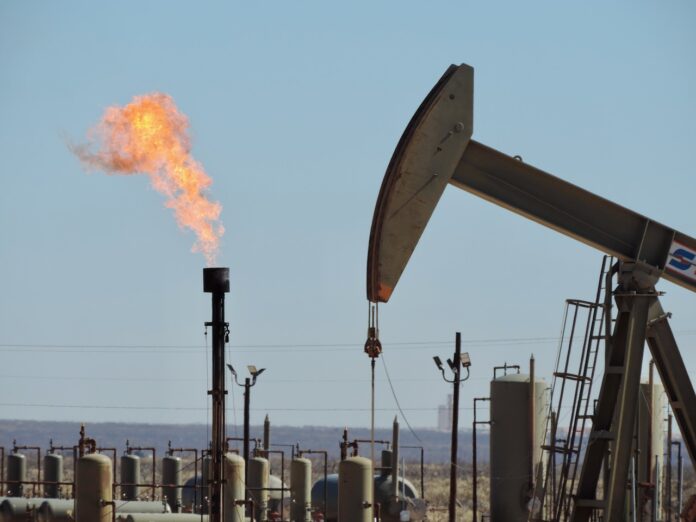
State officials hope to crack down on methane leaks in the oilfield in the last months of the administration of Democratic Gov. Michelle Lujan Grisham.
Lujan Grisham, who is term-limited from seeking reelection, will leave office at the end of 2026. Upon assuming the post in 2019, she issued an executive order calling on state agencies to find ways of curbing air pollution caused by energy development.
The latest attempt at following the order advanced on Friday, Aug. 14, as the New Mexico Environment Department issued its official proposal for the state’s “methane abatement” policy.
The intention is to find facilities where large emissions occurred and impose new requirements on such operators to investigate, report on the causes and fix the leaks.
Proposed language was originally published July 16, seeking public feedback before finalizing the language of the rules and petitioning the department’s governing Environmental Improvement Board for adoption.
Chief among the provisions of the proposal is creation of a “super emitter” program under which third parties certified by the environment department could report large emission events to the state for investigation.
Such an incident would be defined as one emitting at least 50 kilograms per hour of methane in a single event. The proposal also includes language allowing the use of third-party data taken from satellite readings or other sources outside of state agencies in identifying such emissions.
When a plume is discovered, the environment department would notify the owner of the site and require the company to investigate and report on steps taken to mitigate the emissions.
The proposed regulations also include a requirement that by 2031 all oilfield facilities, including those currently in operation, must be outfitted with zero-emission electric pneumatic pumps rather than more emission-prone gas-driven pumps.
The board has the option of scheduling a public hearing on the rules at its next meeting, scheduled for Aug. 28, before voting to adopt them at a subsequent meeting.
‘Compressed’ timeline draws concern
In its petition the New Mexico Environment Department requested that the board schedule a hearing on the matter for Nov. 30, begin its deliberations Dec. 4, and see the final rule published by Dec. 22.
“The Department carefully evaluated these dates with the legal requirements, to present in this petition a coordinated schedule that will enable publication of the proposed rule before the end of 2026 should the board agree to adopt the proposed rule,” read the petition.
The proposed four-month timeline was problematic for the oil and gas industry as Missi Currier, president of trade group the New Mexico Oil and Gas Association, argued there was not enough of 2026 remaining to fully vet the proposed rules and issue meaningful feedback.
“The proposed rule raises substantial technical, legal, operational, and implementation questions that require additional evaluation before advancing a formal rulemaking petition,” she said.
New Mexico Environment Department Cabinet Secretary James Kenney said the rule was needed, and soon.
He said methane leaks contribute to climate change, extreme weather events and wildfires while wasting valuable natural gas that could be sent via pipeline for sale or further processing.
“Methane leaks result in climate change, air pollution and waste of New Mexico’s natural resources,” Kenney said.
He also pointed to the department’s 2022 “ozone precursor rule,” which increased monitoring and reporting requirements for volatile organic compounds known to cause ground level ozone – also known as smog – in certain high-ozone counties.
These include Eddy, Lea and Chaves counties in the southeast region amid the Permian Basin, as well as Dona Ana County along the U.S.-Mexico border and San Juan, Sandoval and Rio Arriba counties to the north near the San Juan Basin in the Four Corners region.
Kenney argued the super emitter program would continue such “progress” he said has been made in reducing air pollution during the Lujan Grisham administration.
But Currier pointed to the ozone rule’s two-year public feedback and amendment process before it was enacted, allowing the industry and others to evaluate the technical, complex provisions it contained.
“For example, the ozone precursor rulemaking took approximately two years to complete; this proposed rule is comparatively technical and consequential but has been proposed on a markedly compressed timeline,” she said.
Currier also contended such rules could be consequential for the industry, which she said was already investing “billions of dollars” to reduce its own pollution.
The proposed rules could also contradict other state and federal policies, Currier said, and restrict oil and gas operations she argued were critical to New Mexico’s economy.
“The proposed rule creates inconsistencies with current state and federal regulatory frameworks and could negatively impact business across the state,” she said.
Managing Editor Adrian Hedden can be reached at 575-628-5516, or @AdrianHedden on the social media platform X.