
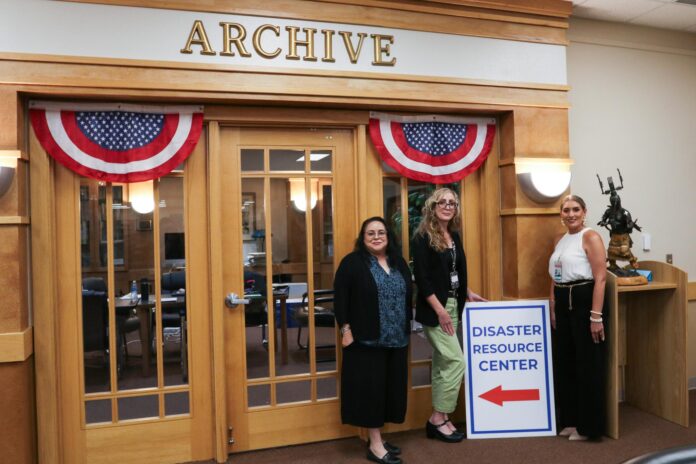
The Home Recovery Program in Lincoln County is offering workshops and town hall meetings to assist residents with applying for funds to be put towards rebuilding homes that were affected by natural disasters in 2024.
The New Mexico Department of Homeland Security and Emergency Management’s Home Recovery Program was made to assist homeowners whose house was damaged by the South Fork and Salt fires, and subsequent flooding events in Lincoln County, according to the DHSEM website. The program also serves Chaves County, for homes damaged or destroyed by the severe flooding in 2024, according to deputy project manager Andrea Niehaus.
“The New Mexico Home Recovery Program can provide repairs, rehabilitation and in some instances even new construction to residents in Chaves County and Lincoln County who apply for the program and are found eligible,” Niehaus said.
Residents can receive funds ranging from $5,000 to be put towards minor repairs to up to $350,000 for home rebuilding, according to the program’s application. The funds will be used to pay for the approved work to be completed, not provided to the homeowner to be used at their discretion, according to Niehaus.
The funding for the project comes from a U.S. Department of Housing and Urban Development allocation of over $137 million to the state of New Mexico in Community Development Block Grant-Disaster Recovery funding, according to the program’s action plan.
“There’s very strict compliance guidelines (from HUD) related to construction, reporting related to construction, and so the state has taken on management of construction vendors to make sure that the program is in compliance,” Niehaus said.
For Lincoln County residents interested in more information, the next monthly town hall will be held on Sept. 15, from 5:30–7 p.m. at ENMU-Ruidoso, 709 Mechem Drive. Workshops are also held every Tuesday and Thursday from 9 a.m. – 4:30 p.m. at the Ruidoso Public Library, 107 Kansas City Road.
For Chaves County residents, the next monthly town hall will be held on Sept. 23 from 5:30–7 p.m. at ENMU-Roswell, 52 University Boulevard. Workshops are also held on Tuesdays and Thursdays from 8 a.m. – 4:30 p.m. at ENMU-Roswell, 52 University Boulevard and from 10 a.m. – 4:30 p.m. at the Roswell Public Library, 301 Pennsylvania Avenue.
The workshops and town halls will continue through December of this year, while the program as a whole has until 2031 to spend the funds allocated by HUD, according to Bureau Chief Andrew Kloefkorn.
“I think at the end of the six years, we want to go back to HUD and say we actually had to spend some of our own money because we ran out,” Kloefkorn said. “I think that’s going to be a good day if we can if we can accomplish that.”
Program eligibility
In order to be eligible for the program, residents must have owned and occupied their home in Lincoln or Chaves County during the time of the disasters and still own and occupy the same home, with documented, unrepaired damage from the disasters, according to the DHSEM website. Additionally, residents must be up to date with any mortgage and property tax obligations.
Residents must also meet a household income requirement of at or below 120% the area median income. For a family of five in Lincoln County, this means making $95,650 or less as a household. For a family of three in Lincoln County, this means $79,700 or less and for an individual in Lincoln County, $62,000 or less. A complete table of income categories can be found under the project’s page on the DHSEM website.
“If you think you qualify for this program or need help from it, we encourage you to apply,” said DHSEM Director of Communications Danielle Silva. “Even to get that call back from a case manager or someone like that who can let you know that you’re definitely yes or no eligible and here’s some other options if you’re not.”
Priority will be given to “low-income” and “very-low” households and those with increased vulnerability factors such as children under the age of 18, seniors 62 and older or a person with disabilities, according to the program’s application packet.
The process
Applicants of the program are asked to complete a 44-page application that requests a wide variety of information and documentation about the home, its occupants and any previous assistance received.
“I think that’s why the application process is so long and so cumbersome, because of all of the different requirements that HUD is having us verify and check,” said Kloefkorn.
The program offers workshops to assist interested parties with their applications, according to the DHSEM website. Officials recommend speaking with a representative from one of the workshops before starting the application.
Each property must undergo multiple environmental assessments and be reviewed by a site assessor to determine the damage that can be addressed.
“It’s a case by case basis,” Niehaus said. “We know every resident family has different recovery needs, and so the site assessor’s job out on the property is to identify what damage was related to the disaster, so that we can provide assistance to address that damage.”
The program has the sole discretion to determine the work to be done on a property, including what “structures, materials, and items on the Property will be assessed, removed, repaired, rehabilitated, reconstructed, or newly constructed,” according to the project’s application.
“The New Mexico Home Recovery Program then develops that scope of work and provides the option to a resident to participate with the repairs that we found, or to decline assistance from the program,” said Niehaus.
The work will be completed by a contractor hired through the federal procurement process by the program, Niehaus said.
Kloefkorn said the estimated average timeline for construction is currently 100 days but said they will have a better understanding of how long the process will take once the first round of houses are completed. He is hopeful to have the first round done by the beginning of next year.