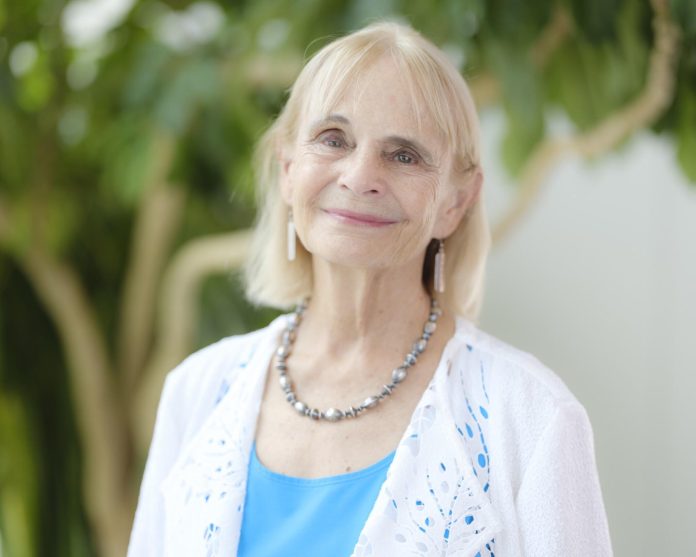
Anne Hillerman, a longtime New Mexico journalist and daughter of famed novelist Tony Hillerman, has found great success in her second creative life as a novelist.
Hillerman, who wrote for both the Santa Fe New Mexican and the Albuquerque Journal, has continued her father’s Joe Leaphorn-Jim Chee series of novels, and she’ll have a new entry — Bloodline — published in March of 2027. She also has a new fiction series slated to be published in 2028, and she spoke to the Alamogordo News about her life in art ahead of her upcoming book reading at Otero Artspace on July 17.
Are you reading from one of your upcoming books or one of your books that’s already been published?
That’s a good question! Originally, when we set this up, I was planning only on reading from my newest book that was published, Shadow of the Solstice, and from the book right before that, Lost Birds.
But since then, my next book that’s coming out in March, Bloodline, has kind of been put on the fast track. So I might read from that! I haven’t decided yet.
That’s so exciting that you have a new book coming out in March, and I understand you have an entire new series coming out in 2028? How have you managed to be so prolific, to stay on schedule of writing a book a year?
I guess just because I love it. And also, I’m lucky. I’m married to a guy (Dave Tedlock) who’s also a writer, and he takes care of a lot of the details of life.
You know, maybe the dog gets sick. We just put a new drip system in here, and we put in a new tree and it looked bad. It wasn’t really working on that tree, and he just takes care of all that stuff. I’m really lucky to have a a partner who kind of frees me to focus real clearly on my creative work.
When you began branching out from journalism to novels, was that planned or just a fun diversion for you?
The short answer is, ‘No, it wasn’t planned.’ I had written a non-fiction book about the places that really resonated with my Dad, Tony Hillerman, on the Navajo nation. To do that book, I re-read all of his novels.
And then often after you publish a book, if you’re lucky you get invitations to go and talk about your book. So I did that.
It seemed like whenever I wanted to talk about my book — people were very kind — but what they really wanted to know was, ‘Will there be any more stories about Joe Leaphorn? What about Jim Chee?’
And I’d say, ‘Well, no.’
Really, by the time Dad died, he didn’t have any manuscripts that somebody could brush off. He didn’t have anything that was almost finished. And I heard that so many times, and all this time, I’m really missing my Dad.
But then it occurred to me: I’m going to miss these characters as much as the readers are.
That stepped into going into my Dad’s world in the way that fans appreciated him. That gave me the idea, and I guess the courage, the gumption, to see if I could write a novel.
It must’ve been a daunting challenge to continue a world that people loved so much.
I think a lot of times when people are writing a first novel, they do their very best.
But really in the back of their mind they’re thinking, ‘Gee, I’ll be lucky if everyone I went to college with sees this in the bookstore and buys it.’ They’re not necessarily following in the footsteps of a NY Times best seller.
There were a lot of ways I could’ve embarrassed myself. It was something I never anticipated and it’s been such a glorious way to spend these last 15 years.

How does your voice change between journalism and literature? Do you think your journalism voice informs your voice as a novelist?
Yes, I think it does. One thing, as a journalist, that you really learn to do is listen.
I think all those school board meetings and city council meetings and planning commission meetings, all of those things gave me a chance to really listen to people. And listen to people who were full of passion. At the time, I wasn’t thinking that I’d be writing fiction. But in retrospect, I think it really did help me in terms of dialogue.
And the other thing that helped me with journalism — again that I probably didn’t appreciate at the time — was working with editors. No matter what you’re writing, so much of it is collaborative. I do the best I can with my novels. Then I turn them over to my editor. And often she has ideas — really good ideas — that I didn’t think of. And sometimes ideas that I can see why she thought of it, but it isn’t the book I’m writing.
Do you think working in journalism helped you in writing to deadlines?
Really, journalism helped me with that. I know there are people who take 30 years to write a book and then it’s 900 pages or something. But I think because of my journalism background, I knew I just had to give it the very best shot I could.
When the deadline came, I had to turn it in and move on. Nothing is ever written as good as I thought it could’ve been, but the good thing is I always have a chance to write another book.
And it’s the same in journalism. You do a story you’re really proud of, and then you do another story and think, ‘Oh, if only I had another hour it would’ve been better.’
Anne Hillerman will be appearing at Otero Artspace and reading from her work as part of the Otero Arts Reading Series on Friday, July 17th at 6 p.m. Otero Artspace is located at 1118 Indiana Ave.