
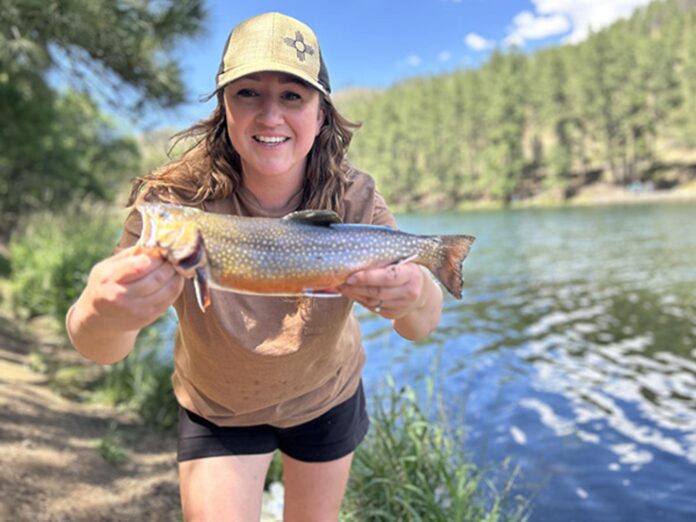
New Mexico fishing enthusiasts angling for trout should head to the lakes and streams of northern New Mexico this week as the popular fish are biting on all kinds of baits and lures.
Along the Cimarron River, trout fishing was fair to good using PowerBait.
At Hopewell Lake, fishing for trout was particularly good while using PowerBait and worms on a bobber.
At Morphy Lake, fishing for trout was fair to good using worms, gold Thomas spoons and Pistol Pete flies.
Trout fishing was good along the banks of the Santa Cruz Reservoir using worms.
At Ute Lake, fishing for smallmouth bass and bluegill was fair to good using worms. Fishing for white bass was incredibly good using spinners.
At the Animas River, fishing for trout was slow to fair using Panther Martins, worms, and hot dogs. Fishing for catfish and bass was fair to good while using live worms and Panther Martins.
Along the San Juan River, fishing for brown trout in the bait section was fair to good when using worms. Fishing for rainbow trout in the quality waters was good when using size-22 red annelid flies, hand-tied flies, pinched crawlers, and worms.
In southern New Mexico at Young Park Pond in Las Cruces, fishing for catfish was good using hot dogs.
In Lincoln County at Bonito Lake, trout fishing was good using garlic and salmon peach PowerBait.
This fishing report has been generated from the best information available at the time of publication.
Summer Catfish Waters are the cat’s meow
Despite its easy-going existence, the catfish is a powerful fighter on a hook, as experienced anglers will tell you.
New Mexico waters support three species of catfish: the channel, flathead and blue. Catfish are widely distributed in New Mexico because they have adapted well to life in reservoirs, though they are also found in rivers. Channel and flathead catfish each have eight black barbels (whiskers) near the mouth and thick, smooth, scaleless skin. Their fins are dark and soft, except for portions of the dorsal and pectoral fins, which are sharp and serrated and can be venomous.
Young channel catfish are silvery blue gray with black spots and a forked tail. Once they reach maturity, at about 12 inches, their coloration darkens markedly, and their spots diminish. Although channel cats prefer clear, slow-moving water, they’re highly tolerant of turbid water. They can grow to over 30 inches, though 12- to 16-inchers are more common catches in New Mexico waters.
In spring and early summer, when water temperatures are between 60- and 72-degrees Fahrenheit, catfish are easy to catch, so long as you remember to fish the bottom when the sun is off the water. The only thing that affects a catfish appetite is water temperature. Below 40-degrees Fahrenheit, it has no interest in feeding.
During daytime hours, murky backwaters of coves or slow water stretches of river are good places to fish from the bank or with waders (check out the bottom structure first). Use a float, small weight and chunks of bait or bait on a hook by itself.
Nighttime is when catfish come alive for most fishermen. They tend to feed by night, especially after summer rains when they search turbid waters with their barbels for food.
During the day, catfish seek out dark, deep pools with submerged logs, rocks, or other debris.
Special summer catfish waters
Many small lakes and ponds through New Mexico are stocked from April-September with 17-inch or longer channel catfish. These waters offer great opportunities throughout the summer to catch a gigantic fish.
“Special Summer Catfish Waters provide angling opportunities in urban areas where a reservoir may not be close by,” said Edward Enriquez, warmwater fisheries supervisor for the Department.
On stocking day, six hatchery trucks travel all over New Mexico to deliver an approximate total of 9,000 pounds of channel catfish to our fishing waters. The Department’s weekly stocking report details which waters have been recently stocked.
To make these unique angling opportunities possible, reduced bag limits (two per day) have been established on these waters. Trotlines may not be used in Special Summer Catfish Waters.
This special catfish limit applies to: Alto Lake, Bataan, Blue Hole Park Pond, Bosque Redondo, Carrizozo, Chaparral, Conoco Lake (Loco Lagoon), Corona Pond, Dennis Chavez Pond, Escondida, Estancia Park Lake, Eunice, Grants Riverwalk Pond, Greene Acres, Green Meadow, Harris Pond, Jal Lake, Lake Van, Liam Knight Pond, McGaffey Lake, Ned Houk, Oasis State Park, Pecos River within Villanueva State Park, Perch Lake, Rancho Grande Ponds, Timberon Ponds, Tingley Beach, Trees Lake and Young Pond.