Workers could face higher doses of radiation at a nuclear repository near Carlsbad under a proposed change in federal policy.
U.S. Energy Secretary Chris Wright earlier this year called for removal of the so-called ALARA (as low as reasonably achievable) principle that guides how the agency limits worker exposure to radiation at nuclear facilities.
In a Jan. 9 memo to department leadership, Wright pointed to a May 23, 2025, executive order issued by President Donald Trump that stated the U.S. nuclear sector had “succumbed to overregulated complacency” and demanded federal agencies remove policies that could slow the development of nuclear energy.
The ALARA principle was first devised in 1954 and has since been used by the federal government to require that workers avoid exposure to radiation that does not provide a direct benefit, regardless of the dose – big or small – according to the Centers for Disease Control.
Wright’s memo suggested that radiation doses up to 10,000 millirems per year were not proven to be harmful, and argued new regulations could use such a benchmark instead of requiring doses be “as low as possible.”
A millirem is a unit of measurement equal to 1/1000 of a rem, typically used to calculate the level of exposure to radiation for a person by measuring the rate that it breaks down in human tissue.
The average U.S. resident is exposed to about 620 millirems per year, according to the Nuclear Regulatory Commission.
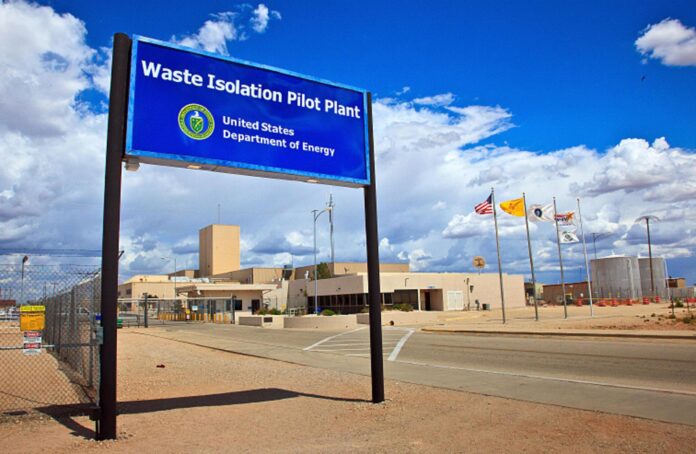
At the Waste Isolation Pilot Plant (WIPP) near Carlsbad, the Energy Department disposes of transuranic nuclear waste (TRU), which is clothing materials, equipment and other debris irradiated during nuclear activities.
The waste is buried at WIPP in a salt deposit about 2,000 feet underground. The salt gradually collapses on the waste, burying the refuse and blocking radiation from escaping.
Workers who handle the waste, maintain the underground and mine new disposal areas are represented by the United Steelworkers (USW) Local 12-9477.
The USW also represents workers at other energy department sites that send waste to WIPP including the Hanford Site in Washington and the Idaho National Laboratory.
James Cobb, union president at WIPP, works as a hoist man maintaining the facility’s elevator system that moves people in and out of the underground, lifts mined salt to the surface and lowers waste for disposal.
In a June 5 interview, Cobb said eliminating the ALARA standard could lead to higher radiation exposure and subsequent health impacts for workers.
Cobb said WIPP is not a “high dose” facility but the possibility the dose could increase without the ALARA principle in place was troubling. He said the change could prove dangerous at higher-radiation sites where the union represents workers and where nuclear weapons are developed, such as the Hanford Site.
“We’d like to leave it where it is,” Cobb said. “It’s a major concern, even for us (WIPP workers). We could get a higher dose. Our concern is people end up having cancer.”
Valerie Gohlke, spokesperson for the Department of Energy’s Carlsbad Field Office, said the change was unlikely to affect the WIPP site and would ensure nuclear operations throughout the U.S. “are more efficient.”
Gohlke said the highest dose received by any worker at WIPP was less than 100 millirems per year, compared with the Department of Energy’s agency-wide limit of 5,000 millirems annually.
“These new regulations would have little if any impacts at the WIPP site, allowing WIPP to be even more flexible, efficient, and effective in its already very safe radiological operations,” Gohlke said.
WIPP limits armed guards
Another change that drew concern among the WIPP workforce, Cobb said, was the recent removal of human guards around the facility’s perimeter.
Gohlke confirmed Wednesday, June 24, that the energy department was limiting manned security along portions of the fence line surrounding WIPP and at a secondary entrance gate on the north end of the site.
The main gate on the west side of WIPP, the primary pathway for people and waste, is still guarded by armed staff.
Gohlke said the other guards were being replaced with a series of cameras and digitally monitored turnstiles using a scanned card system as part of a broader “modernization” of WIPP’s infrastructure.
But Cobb said the change could leave the facility susceptible to terrorist attacks or other incidents.
“There’s the possibility of having someone hijacking a truck or an individual entering the site without being checked,” Cobb said. “It’s an easy way if there’s a terrorist attack to steal someone’s badge and drive right into the facility. If we can see that it’s an issue from inside the facility, someone outside could see it.”
WIPP’s Security Risk Assessment Team analyzed the “upgraded” security system, Gohlke said, and concluded the system would improve security by taking advantage of more advanced technology.
“After evaluating all threats, the (assessment team) concluded that this new integrated approach significantly lowers the overall risk to personnel and site operations by enhancing security with a more responsive and integrated protective force strategy,” Gohlke said. “The implemented changes are vital, robust and will enhance security and safety at the site.”
Sen. Martin Heinrich (D-NM) criticized the Department of Energy for recent changes to WIPP and department policies, which he said could put workers and the surrounding community at risk.
He said the WIPP union had contacted his office for assistance in opposing the changes.
“The health and safety of the Carlsbad community and WIPP workers must always come first,” Heinrich said. “When workers say their health and safety is at risk, we must listen to them.”
Managing Editor Adrian Hedden can be reached at 575-628-5516, or @AdrianHedden on the social media platform X.