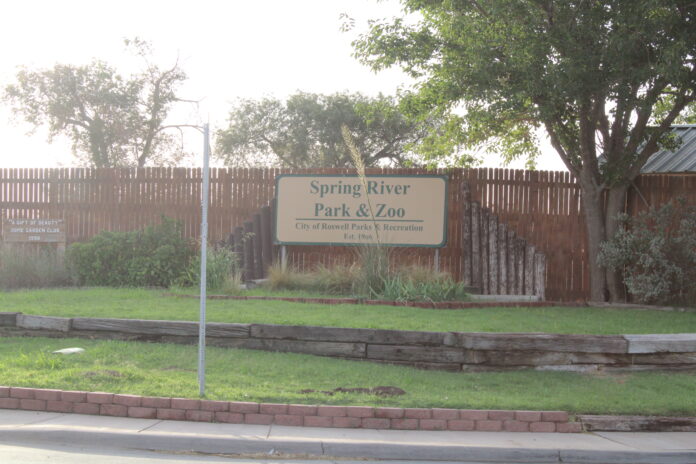
Roswell city councilors voted 8-2 Wednesday, Sept. 10, to table a resolution that would have closed the Spring River Zoo to make way for a new multi-use facility.
Ward 2 City Councilor Riley Armstrong made the tabling motion, which postpones action on the resolution until a public meeting can be held within the next 30 days to get feedback from Roswell residents.
The resolution, which advanced out of the council’s Legal Committee on a 4-0 vote Aug. 31, would authorize the city manager’s office to “wind down” operations of the zoo and the former Peppermint Park, and make arrangements for animals to be sent to other locations. This would be accomplished by the end of fiscal year 2027, which is June 30, 2027, according to the resolution.
Fiscal years in government budgeting run from July 1 to June 30 and are named for the year they end in.
“To keep this thing moving forward, my idea is to table it so that we have a public hearing within the next 30 days,” Armstrong said.
Councilors Cristina Arnold of Ward 1 and Juliana Halvorson of Ward 2, sponsors of the resolution, voted against the tabling motion.
Voting for the motion were Armstrong along with councilors Juan Oropesa of Ward 1; Edward Heldenbrand and Kurt Gass, both of Ward 3; Robert Corn and Darrell Johnson, both of Ward 4; and Angela Moore and Carlos Marrujo, both of Ward 5.
Amalia Martinez, Roswell city clerk, told the Roswell Tribune in an email Monday, Sept. 14, that her office is still working out the details on a time, date and place for the public hearing.
The resolution also directs the city manager to put forth a plan for construction of a new adult center and other facilities damaged in the Oct. 24, 2024 flood in which 7 inches of rain fell in downtown Roswell within six hours. Municipal facilities damaged by the floodwaters were eligible for federal relief dollars via the Federal Emergency Management Agency (FEMA)
The Federal Emergency Management Agency (FEMA) would reimburse the city about $13.1 million in total of the complex project’s overall $17.5 million price tag, including $6.6 million to replace the Roswell Adult Center, which was damaged by the flood.
The remaining $4.4 million would be paid for using revenue from a three-eighths of 1% local option gross receipts tax the city put in place to cover flood recovery expenses. The state would allocate $9 million in zero-interest loans to provide upfront cash while the city awaits FEMA reimbursement, according to Hess Yntema, Roswell city manager.
Other aspects of the complex would likely include replacing a scout clubhouse, a tennis pro shop at Cahoon Park and a Department of Parks and Recreation storage facility damaged by the flooding. A pond and bridge located on a part of the zoo property battered by the flood would also be fixed.
No plans have been finalized on what the complex will include, but a concept map that accompanied the resolution shows that the complex could include a community garden; basketball, tennis and pickleball courts; updated playground equipment; a new dog park; and retention areas to minimize future flood damage.
Councilors and others at the meeting said they wanted to hear from local residents before deciding whether to shutter the zoo, which has been located at 1306 E. College Blvd since 1966, and what if anything should be built on the property.
“However it comes out in the wash, I just want input from the public,” Armstrong said.
Moore said she was hesitant to approve the resolution. She noted that over the years the city has reduced funding for the zoo, and before it is closed and something is built in its place, she wants to hear from constituents about how to move forward.
“I think we need to talk this through a little bit more since we’ve taken so much away from the city and the flood took the rest away,” Moore said.
Halvorson and Arnold insisted that the resolution represents a first step in what is likely to be a years-long process to rebuild public facilities along the Spring River Corridor damaged in the flooding. Public input would be sought before any plan is ultimately approved, and the map was meant simply to show what could be done with the zoo property, Halvorson said.
“The plan is to start retiring the animals to homes that will take care of them and start having public hearings and working with engineers to come up with an actual plan,” she said. Halvorson added that the city cannot use FEMA dollars to make upgrades to animal areas and other parts of the zoo, because much of it was not directly damaged by the flood.
“We can fix the pond, but we can’t rebuild the animal enclosures,” she said.