President Donald Trump’s administration joined Carlsbad officials in opposing a proposal to alter nuclear waste storage at a nearby repository.
The Environmental Protection Agency was the latest government entity, and by the far the largest, to resist the amendment offered by the state in April that would require more nuclear waste from within New Mexico sent to the Waste Isolation Pilot Plant for disposal.
The agency argued the state’s proposal could violate the U.S. Constitution and lead to intervention by the president.
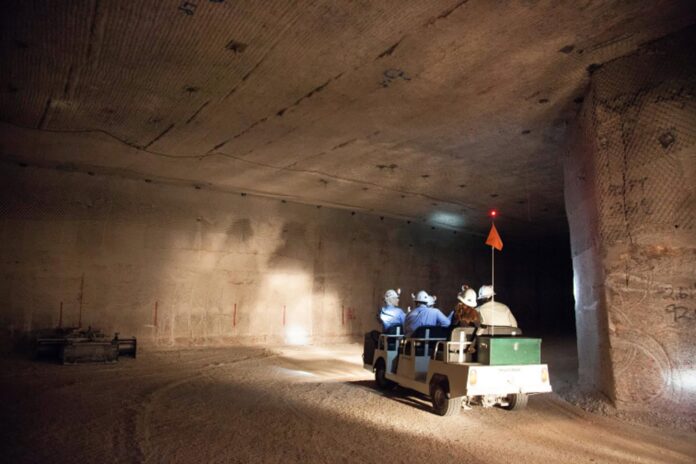
Irradiated material known as transuranic (TRU) waste is buried at WIPP in a salt deposit about 2,000 feet underground. The salt gradually collapses on the waste, burying the refuse and blocking radiation from escaping.
About half the waste disposed of in this way at WIPP has come from Idaho National Laboratory since the repository opened in 1999.
That’s because of a 1995 settlement agreement between Idaho and the U.S. Department of Energy, which operates the WIPP site and was required to set aside half the facility’s shipment capacity for Idaho waste.
But the high percentage of out-of-state waste was a sticking point for the New Mexico Environment Department, which oversees WIPP’s state operations permit.
On April 23, the state proposed an amendment to the 10-year permit – last renewed in 2023 – stipulating that 55% of shipments to the repository from 2027 through 2031 come from Los Alamos National Laboratory.
In 2032, the revised permit would require that the northern New Mexico nuclear site account for 75% of shipments to WIPP.
The proposal drew immediate backlash from local business leaders in the Carlsbad area, along with the Carlsbad City Council and Eddy County Commission. The local government entities signed resolutions opposing the change in May and June, respectively.
Opponents of the change argued that requiring Los Alamos to account for more than half the waste shipped to WIPP could limit the overall nuclear waste sent to the facility.
No more than five shipments come from Los Alamos in a week, compared to the energy department’s goal of 17 weekly shipments from across the U.S.
‘Significant concerns’
A public comment period on the proposal closed on June 22, the same day the Environmental Protection Agency’s Region 6 administrator Scott Mason submitted a letter to the state opposing the changes.
That was after an initial 45-day comment period scheduled to end June 8 was extended. After the comments were gathered, state and federal officials entered negotiations. If no agreement is reached a public hearing could be scheduled.
Mason said the state’s proposed amendment “raised significant concerns” at the federal level and would “interfere” with nuclear waste cleanup across the U.S.
Region 6 of the Environmental Protection Agency covers Arkansas, Louisiana, New Mexico, Oklahoma and Texas, along with 66 tribal nations, according to the agency’s website.
In his letter, Mason argued the change could violate the U.S. Constitution’s Supremacy Clause, which he contended bars states from impeding federal actions – in this case nuclear waste cleanup.
And because waste is moved into New Mexico from other states such as Idaho, the permit change could also run afoul of the Constitution’s Commerce Clause, Mason wrote, by “unreasonably burdening” interstate commerce.
The administrator concluded that the “proposed modifications clearly favor the in-state (Los Alamos) waste over waste from out-of-state generators. Any such overt discrimination would impermissibly impede interstate commerce.”
Should the permit modification take effect, Mason wrote, Trump could use his authority to issue a waiver of the state regulation. Mason said the Environmental Protection Agency would likely advise the Department of Energy to seek such an exemption.
“EPA understands and respects NMED’s desire to address contaminated sites within New Mexico’s borders,” the letter read. “To remedy the significant issues discussed above, NMED should reconsider the proposed modification.”
‘Strengthening’ the rules
Despite these concerns, New Mexico Environment Department Cabinet Secretary James Kenney maintained that the state was within its rights to impose the new conditions. He said New Mexico was often deprioritized for nuclear waste disposal.
“We are strengthening the Waste Isolation Pilot Plant’s operating permit to affirm the commitments made to protect the health of communities across the United States, including New Mexicans,” Kenney said in a statement.
Janet Greenwald with the northern New Mexico-based nuclear watchdog group Los Alamos Downwind Neighbors said in a June 22 letter of support that cleaning up the Los Alamos lab’s so-called “legacy waste” left over from the Cold War and Manhattan Project was critical to the safety of her community.
“All our communities are important and we as a state will stand up for them against the sometimes seemingly uncaring federal government and its often-damaging policies,” Greenwald wrote.
On the other side of the argument, the Department of Energy’s Idaho Operations Office said in a letter of opposition the modification would cut shipments from Idaho from seven per week to 12 per year.
The June 22 letter signed by Tanner Crowther, chief counsel for the Idaho office, stated there were 970 shipments of waste remaining at the Idaho lab that could take 60 years to clean up should the state’s proposal take effect.
That would push Idaho cleanup out to 2086, Crowther wrote, endangering the Snake River Plain Aquifer as the waste awaits disposal.
The aquifer stretches for about 10,800 square miles in southern Idaho near Yellowstone National Park and provides groundwater supplies to about 3 million acres of farmland, according to Idaho State University.
Prolonging waste disposal from the lab would also incur up to $5.8 billion in added costs to the federal government while potentially leading to litigation for violations of the 1995 agreement, Crowther wrote.
“The proposed WIPP permit modifications represent a significant mission impact to the (Idaho National Laboratory), its stakeholders and its programmatic funding,” read the letter. “The conditions proposed by NMED intrude into management of facilities and operations of permit holders.”
Managing Editor Adrian Hedden can be reached at 575-628-5516, or @AdrianHedden on the social media platform X.