
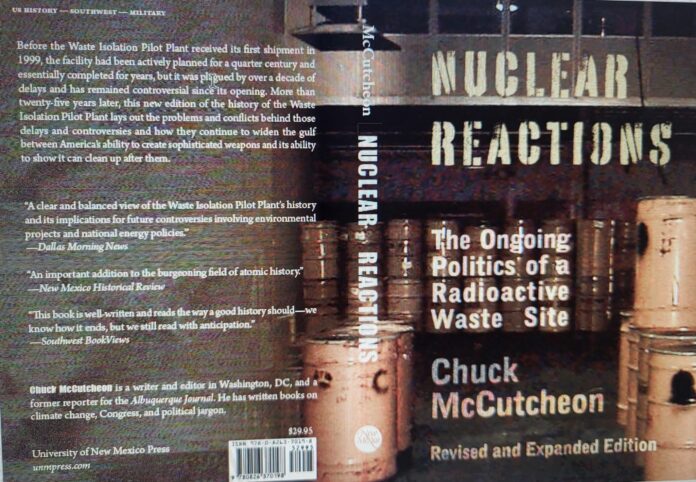
A lot has changed at the Waste Isolation Pilot Plant since Chuck McCutcheon published his book about WIPP in 2002.
That was just three years after the nuclear waste disposal facility 30 miles east of Carlsbad opened for business.
In an updated edition of his Nuclear Reactions published Nov. 17, McCutcheon endeavors to expand upon his work 24 years later, adding three chapters to cover developments at WIPP between 2002 and 2026.
McCutcheon’s interest in WIPP was sparked when it was being developed in 1988 and he was asked to help cover the project while working as a reporter at the Albuquerque Journal. He worked at that paper from 1986 to 1995, including a stint at its Washington, D.C., bureau then worked from 1996 to 2002 at Congressional Quarterly where he continued to write about the nuclear waste repository.
Most recently, McCutcheon covered nuclear issues and climate change as an editor at Axios from 2023 until April 2026 when he became an independent writer and editor.
McCutcheon will be at the Carlsbad Public Library at 6:30 p.m. Nov. 19 to sign copies of his book and answer questions from readers.

The waste disposed of at WIPP, known as transuranic (TRU) waste, is made up of clothing, equipment and other debris irradiated during nuclear operations around the country. The waste is sent to WIPP by truck and buried in an underground salt deposit about 2,000 feet underground.
McCutcheon, 63, also devotes part of the new edition to the politics at play amid a 10-year renewal of WIPP’s state operations permit in 2023 that led to a tense mediation and a settlement agreement between the U.S. Department of Energy and the New Mexico Environment Department.
The concept is that the naturally occurring salt blocks radiation from escaping, but maintaining the massive mine has presented a unique logistical challenge and fueled an ongoing series of policy debates throughout WIPP’s 27-year history.
Chief among the hurdles was an accidental radiological release in 2014, after a drum sent from Los Alamos National Laboratory ruptured in the underground, leading to a three-year closure of WIPP’s primary operations.
Another addition was a chapter on the Blue Ribbon Commission on America’s Nuclear Future, created during the administration of former President Barack Obama. The commission produced a 2012 report that launched WIPP into the national spotlight, McCutcheon argued, as an example of how future nuclear sites could be developed in the U.S.
The Carlsbad Current-Argus caught up with McCutcheon ahead of his Carlsbad book signing to talk about the updates to Nuclear Reactions.
Why did you add to this book?
“Well, obviously because a lot of time has passed since, you know, 2002, and I had a lot of people tell me after the 2014 accident, you really need to update your book, but I didn’t want to just do that.
“I wanted to provide a fuller picture, and I wanted to include other events and other things like the Blue Ribbon Commission elevating within the national dialogue and the fighting that’s been going on between the state of New Mexico and the DOE and kind of illustrating how that process actually produced an agreement.”
How is the revision beneficial?
“I think it’s a benefit because, you know, it has endured now for 27 years and that provides even more of an opportunity to study it and see what works and see what hasn’t.
“There’s a recognition that they need to upgrade some of the aging infrastructure … the consequences of the 2014 accident. Putting in a lot of new facilities, I think, was important to highlight that they needed to make changes.”
How has the WIPP debate evolved?
“There’s always going to be animosity, but I don’t think that there is quite as much animosity as there used to be, certainly in terms of the relationship between some non-DOE federal agencies and the environmental groups.
“It was a Cold War facility that was proposed during the Cold War, but it had to be built in a post-Cold War world. And the DOE, by its own admission, in hindsight, wasn’t used to the level of scrutiny that post-Cold War sites got.”
How much longer could WIPP operate?
“I got to say, I have no idea. I just think that it’s going to depend so much on the priorities of future presidential administrations and governors and state agencies and Congress. And I think it’ll also depend on the degree to which people’s attitudes towards nuclear waste sort of change.
“Carlsbad has always had the perspective that we’re helping to fulfill a national mission.”
Will New Mexico have a role in the U.S.’ nuclear future?
“I think they could certainly make a good case for having some kind of role. Whether that role includes another repository, it’s just really, it’s really hard to guess. It’s just, it’s hard to say until we know what happens in terms of the technology, in terms of the politics, and what else transpires.”
Managing Editor Adrian Hedden can be reached at 575-628-5516, or @AdrianHedden on the social media platform X.