A 20-year-old cable was what caused an elevator to drop to the bottom of an underground nuclear waste repository near Carlsbad.
The incident was reported at the Waste Isolation Pilot Plant Aug. 19 when a hoist used as an emergency egress to move people out of the underground facility fell about 1,600 feet to the bottom of the mine. The hoist was unoccupied when it fell.
At WIPP, the Energy Department disposes of transuranic nuclear waste (TRU), which is clothing materials, equipment and other debris irradiated during nuclear activities.
The waste is buried at WIPP in a salt deposit about 2,000 feet underground. The salt gradually collapses on the waste, burying the refuse and blocking radiation from escaping.
WIPP operates four lifts at the facility: a salt shaft to move mined salt to the surface; a waste shaft that moves material for disposal into the repository and people in and out; and two others functioning as air intakes. The air intake shafts can also be used to move workers out in case of an emergency.
One of those intake shafts was where the hoist collapsed in August.
A fifth shaft used to exhaust air from the underground does not have hoisting capability.
Ryan Flynn with Salado Isolation Mining Contractors, the company hired by the federal government to operate WIPP, said officials determined after an investigation that a rope acquired in 2006 snapped during a test of the lift.
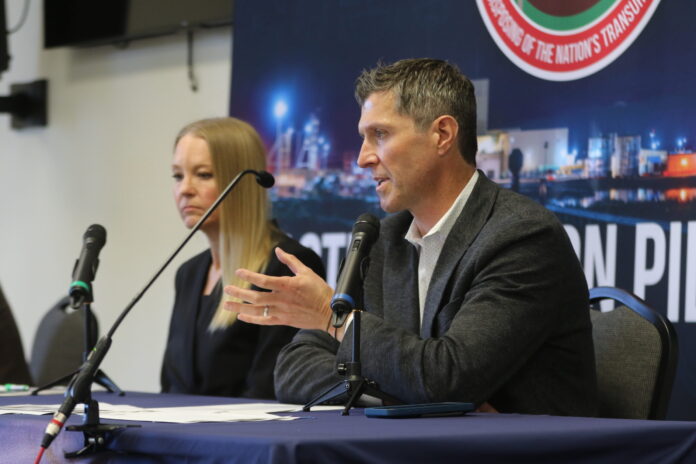
Flynn’s explanation came during a Wednesday, Nov. 4, community forum held in Carlsbad and attended by about 20 WIPP officials, local leaders and others.
Moments before the collapse, Flynn said, workers conducting the test noticed the hoist was moving “abnormally” while it was being lowered and attempted to bring it back to the surface.
Meanwhile, the hoist cable connected to the lift itself became entangled with guide ropes, causing it to break, with the conveyance dropping to the bottom of the shaft.
The entanglement was due to the cable being the wrong design for the elevator, Flynn said, explaining it was a “lang-lay” rope where metal fibers run diagonally rather than a “regular lay” rope where the fibers run parallel.
Lang-lay provides more flexibility but also creates more “torque,” Flynn said, which caused the lift to rotate during testing and tangle the cables.
He said the elevator system itself is about “100 years old” and no manual exists to denote which type of cable is the right kind to use.
“The hoist rope and guide ropes had become entangled,” Flynn said. “The force of the movement caused the hoist rope to separate above the conveyance and caused the conveyance to fall down the shaft. “This event was caused by an incompatible rope design.”
There was “no risk” to workers in the underground, Flynn said, nor was any damage to WIPP’s waste drums possible as the event occurred “far from” emplaced waste.
“At no point was there any risk of radiological release or damage to our waste containers in the underground,” he said.
Following the event, Flynn said, work in the underground was halted temporarily but resumed the next day when no additional risk was found.
He said the Mine Health and Safety Administration and New Mexico Environment Department each conducted its own independent analysis as officials sought the “root cause” of the incident.
Since then, WIPP officials have revised their procedures, Flynn said, ensuring stronger oversight of operations to reduce the risk of a similar event in the future.
“We really want to get beyond what happened and the immediate fix,” Flynn said. “We really want to find out why it happened by getting the cause – learn from it to prevent it from occurring again in the future.”
To upgrade WIPP’s hoist system, Flynn said waste shipments would be paused from July 2027 to January 2028, replacing the annual 30-day maintenance outage that typically begins in January.
The Hoisting Capability Project will see the air intake shaft replaced along with another intake shaft on the west side of the mine known as the utility shaft. That shaft will have the capacity to carry up to 75 people in and out when complete, Flynn said.
Los Alamos waste debated
Don Hancock with Albuquerque-based government watchdog group Southwest Research and Information Center complained during the forum that WIPP was not prioritizing nuclear waste from within New Mexico.
Flynn reported that of 305 shipments of waste accepted by WIPP in Fiscal Year 2026 – Oct. 1, 2025, to Sept. 30, 2026 – 116 came from Los Alamos.
That’s only 38% and not enough, Hancock argued, to say WIPP was “prioritizing” Los Alamos waste as mandated in a clause added to WIPP’s 10-year state operations permit when it was renewed in 2023.
“That doesn’t seem like prioritizing Los Alamos waste,” Hancock said.
Mindy Toothman, deputy manager at the Department of Energy’s Carlsbad Field Office, said WIPP can accept up to 17 shipments per week but averages 15 and takes in up to five shipments a week from Los Alamos.
And the shipments vary, Toothman said, between newly generated waste from the National Nuclear Security Administration – a subagency of the energy department that develops nuclear weapons at Los Alamos – and so-called “legacy waste” left over from past nuclear programs such as the Manhattan Project.
“We want to accept as much waste as we can, but it needs to meet all of those shipment requirements. Being able to ship NNSA and (legacy) waste, it allows us to not only address legacy but any waste that comes off the hill,” she said.
Cindy Weehler, a Santa Fe resident who attended the meeting, asked how much of the waste from Los Alamos was considered legacy waste versus newly generated.
“I don’t have the figure on how that broke down with legacy waste and newly generated waste,” Flynn said.
Managing Editor Adrian Hedden can be reached at 575-628-5516, or @AdrianHedden on the social media platform X.