
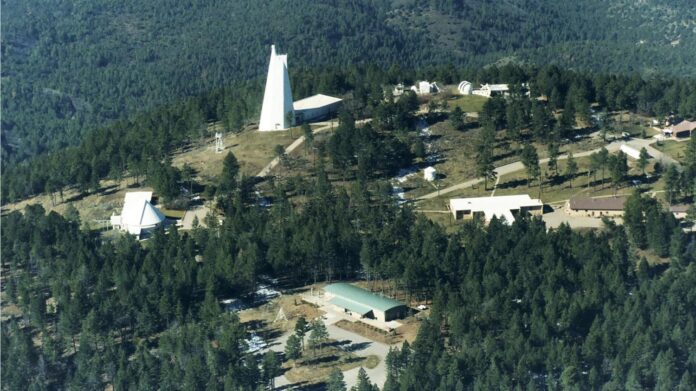
Reporting by Laurel Berry for Alamogordo News
Richard B. Dunn, the designer of the Sunspot solar telescope, needed a way to rotate a very heavy telescope to track the sun. Using a technique from lighthouse architecture, he used liquid mercury, which enabled scientists to smoothly and very easily turn the telescope. That mercury would become the final nail in the coffin for the iconic structure, as well as all of the other buildings on the Sunspot campus, when a leak was discovered coming from a bearing inside the structure.
A community forum to save the Sunspot was held on Wednesday night, Oct. 28, at the Ink Well Innovation Center in Alamogordo, drawing a crowd of supporters and local elected officials. The event, spearheaded by the Basin Alliance and Friends of Sunspot, sought to bring awareness to the National Science Foundation’s (NSF) decision to immediately close the entire compound and adjacent trails in the Lincoln National Forest on January 5, 2026. This despite the agency having completed its nomination for the National Register of Historic Places, which it began in 2018 and completed in 2020.
Anyone driving into Alamogordo along Highway 54 can easily spot the white tower looming large on the edge of the Sacramento Mountains. Indeed, it is visible from many places around town, and reachable by car in less than an hour. A pinnacle on the mountain since 1969, the Richard B. Dunn telescope has operated out of its location at Sunspot Solar Observatory, giving scientists detailed views of the sun. Now the entire site has been slated for demolition, despite support opposing demolition from the Otero County Commissioners, Cloudcroft City Council, and the Alamogordo City Commission. On Aug. 11, 2026, the Alamogordo City Commission passed a resolution officially backing the preservation of the historical site.
The timeline leading to the scheduled demise led many at the meeting to voice skepticism that the process was legal, with some questioning the motives.
“Before a federal agency can tear down a historic site, Section 106, the federal law Look Before You Bulldoze, requires it to study options and to consult with historic preservation officials,” said Sarah Moody, founder of Basin Alliance. “Section 106 does not automatically ban demolition but it forces them to study the options and sign a binding agreement.”
The NSF signed the binding agreement and began studying the issue in 2018, ultimately deciding to transition to partial operations and education by partnering with New Mexico State University (NMSU) and other partners, in 2019. In February 2020, Moody said, historians finished the historic registry paperwork, but it was never turned in.
“This was proof that the campus is historic,” she said. “From 2022 onward the NSF had quietly started planning demolition years before the mercury leak and without telling the public.”
Moody went on with the timeline when the mercury leak in the Dunn telescope was discovered by staff on January 5, 2026. At that point the whole site was closed to the public, despite the leak being small and contained in the structure. On February 26, the NSF ordered the demolition of the entire campus.
“Right now everything comes down to two promises that were made,” Moody said.
As it stands now, the Dunn Telescope is scheduled for complete demolition by the end of March, with the remaining structures being removed by the end of September 2027. This despite an email from the NSF dated Sept. 24, 2026 stating that the other buildings were safe this fall and promising time for the community to come up with a plan to utilize the campus. On Oct. 22, 2026, an appeal was filed with the National Park Service (NPS), which owns the land. “We just got news last night from the NPS saying that it was accepted,” said Moody, thus beginning a 45-day review clock. “They will be ruling on it on December 7, so the Park Service is another place to reach out to [to show support].”
The Advisory Council on Historic Preservation (ACHP) is now formally requesting the NSF Board records to determine if the officials had the legal authority to make the demolition agreement.
“Most observatories are not open to the public,” said Heidi Sanchez, Program Specialist and Education and Public Outreach Coordinator at Sunspot. “They’re doing research. This was a unique situation where we were studying the sun and welcoming the public out there to see what research we were doing.”
She went on to say, “It boils down to the land use agreement. The university cannot take on the liability. That’s not what they were meant to do, taking on the responsibility for all those buildings and being land managers. So it needs to be somebody else. We’ve had great conversations with Otero County and we would love for the county to take it over. Or we could have a private investor or a nonprofit to take over the site. Whoever takes over that site is responsible for all that infrastructure so you still need to be strategic in choosing the buildings that you want to keep and the buildings that you want NSF to take care of.”
The buildings in question include dormitories, research labs, a post office, fire station, cafeteria and the John W. Evans Solar Facility.
“It doesn’t make sense to spend all that money on demolition and then to spend more money to put up a [point of interest] sign,” said Alamogordo resident Russell Davis . “Why not just keep part of it open and save money that way. Like keeping the visitor center and putting up a new small telescope rather than a full demolition.”
Other large telescopes, Kitt Peak Observatory in Arizona and Arecibo Observatory in Puerto Rico, were saved by the NSF and turned into public education centers. Dave Dooling, who is a former education officer at Sunspot, addressed this idea.
“They [the NSF] want it off their books. They are under a tremendous amount of budgetary and bureaucratic pressure right now so I can appreciate them wanting it to be gone,” Dooling said. “The short answer of why they won’t talk to anyone about it? Beats the heck out of me. We have not been able to get a straight answer out of them.”
“It could be something amazing,” Sanchez said of the campus. “With NSF moving out someone else could come in and renovate those buildings and rejuvenate the entire site and open it up for public access. Do star parties out there and RV camping. It could be something this region of southern New Mexico has that doesn’t exist anywhere else in the state and maybe not in any other state. We could be offering something really great to our community and to tourists.”
“The Forest Service is always telling us that they don’t have the money to do anything,” said Otero County Commissioner Gerald Matherly . “We’ve been after them for six or eight years to clean the forest up for wildfire mitigation and they say ‘we don’t have the money.’ So when you tell me that they come in with a $40 million budget all of a sudden, there’s something else in the picture here that nobody’s seeing.”
Moody says that there is still time for community input to shift the outcome for Sunspot. The issue will be addressed at the next Otero County Commissioners meeting on Tuesday, November 10, at 9:00, at the Administration Building, 1101 New York Ave. For more information visit basin-alliance.org/sunspot and friendsofsunspot.com or visit their Instagram and Facebook pages.