
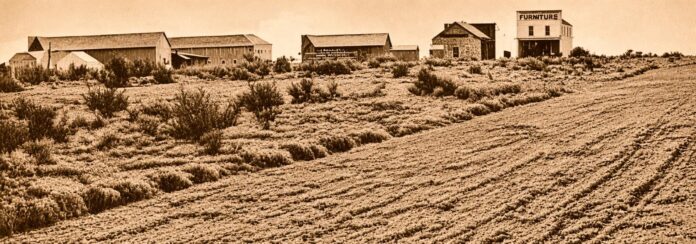
Orogrande, New Mexico, population 28, was founded on wishful thinking. Located 37 miles south of Alamogordo, the little town has a new museum and rock shop, with enough rocks, relics, and stories to fill the shelves — and a couple of wandering souls determined to keep its history alive.
Long before prospectors arrived, the Mescalero Apaches knew the Jarilla Mountains for their turquoise and scarce sources of water. Spanish settlement in the region was limited, in part because of Apache resistance. But by the turn of the 20th century, Anglo prospectors were searching the mountains for something considerably more profitable.
Ol’ Perk and the Two Barrels of Water
Among the early characters was S. M. Perkins, better known as Ol’ Perk.
Perkins owned the Nannie Baird Mine, also called the Two Barrel Mine, because he supposedly traded his claim for two barrels of water. In a desert where water could be harder to obtain than gold, this may have been a perfectly reasonable transaction.
According to local legend, Perk was once captured by Mescalero Apaches and faced almost certain death until his captors noticed his pronounced curvature of the spine, then called a hunchback. The story claims they believed his condition endowed him with supernatural powers and released him.
It’s a colorful tale, although one better regarded as frontier folklore than established history. Whatever the truth, Ol’ Perk joined the long procession of hopeful men who came to the Jarillas searching for fortunes.
Orogrande’s great gold rush, however, began with a man who wasn’t even a prospector.
George Moffett and the gold rush
George E. Moffett was working as an electrician for the T. P. Coal Company in Thurber, Texas when two fellow employees became interested in rumors of gold in southern New Mexico.
Moffett grubstaked the pair, supplying the means for their prospecting expedition. But the possibility of untold riches proved too tempting, and he eventually quit his job and joined them.
The three men located the Little Joe and Cotton Top mines, discoveries that reportedly earned them some $40,000.
According to a later newspaper account, Moffett discovered a finger-sized piece of gold just lying on the ground in the Jarilla Mountains around 1905 while showing prospective Eastern and English investors around the area. News reached El Paso, and prospectors descended upon the little railroad stop of Jarilla Junction.
Gold fever had arrived.
The discovery set off a stampede of prospectors, speculators, businessmen, and assorted opportunists and grifters. Jarilla Junction became Oro Grande —Spanish for “big gold”— a considerably ambitious name for the railroad stop.
People came from all over, convinced riches were waiting beneath the desert floor. Town lots changed hands, mining claims were bought and sold, and some particularly enterprising individuals reportedly sold the same property more than once. An excellent arrangement, provided you were the seller.
The town reportedly grew to several thousand residents. Houses appeared, businesses opened, and tents and hastily-constructed shacks accommodated the overflow. Water was sold by the barrel until a pipeline stretching some 55 miles was constructed to supply the settlement and its smelter.
Moffett became prominent enough to represent Otero County at New Mexico’s 1910 constitutional convention along with Albert B. Fall, future Senator of New Mexico. The boom town never fulfilled its grand promises, but Moffett remained convinced that fortunes were waiting in the Jarilla Mountains.
He probably would have gotten along splendidly with today’s museum operators, Vern and Nancy.
Boosters versus knockers
If Orogrande had one thing in abundance besides rocks, it was optimism.
Early newspaper accounts read less like journalism and more like sales pitches written by men who had invested their life savings in town lots.
Orogrande was destined to become a mining metropolis. Gold, silver, copper, iron, and turquoise would produce fortunes. Railroads would bring commerce, factories would provide employment, and prosperity would spread across the desert like wildflowers after a rain.
There was, however, a problem with people who questioned these predictions. They were called “knockers.”
A booster was a hardworking, forward-thinking citizen who put his shoulder to the wheel and helped his town prosper. A knocker stood on the sidelines, criticizing everything, predicting failure, and generally making himself disagreeable.
Orogrande had no use for knockers.
One newspaper writer declared that the town’s promoters had come not to criticize but to help make Orogrande the talk of the land.
They acknowledged the shortages of water, fuel, schools, churches, and other civilizing conveniences. These were merely temporary inconveniences standing between Orogrande and greatness.
Meanwhile, an El Paso newspaper reported that English investors had purchased 11 mining claims for $75,000. The community was jubilant, and Otero County was supposedly on the verge of a great awakening. Orogrande was going places.
Unfortunately, much of the prospectors’ money was going into holes in the Jarillas, like silver dollars disappearing into a slot machine.
Some people made money, of course. The old adage was, “Don’t dig for gold; sell shovels.” Or real estate — or beer.
Not everything that glitters…
The Jarilla Mountains contained valuable minerals, just not in the quantities the boosters promised.
Iron, silver, copper, and turquoise attracted miners. Iron was particularly useful during the railroad-building era, while turquoise brought the little town a touch of Fifth Avenue sophistication.
Early newspapers boasted that turquoise from the district was finding its way into Tiffany’s workshops. They described gold nuggets, silver deposits, and mountains of iron as though the Almighty had arranged them specifically for Orogrande’s investors.
But a promising claim doesn’t necessarily become a profitable mine, and a town built on expectations can decline as quickly as it grows.
The population dwindled. Businesses closed, buildings deteriorated, and many hopeful prospectors departed for the next opportunity. But Orogrande wasn’t finished.
A Place to Stop Along the Way
Orogrande had something else going for it: location.
Situated between Alamogordo and El Paso, approximately 60 miles north of the Texas city, it became a convenient stopping place for travelers needing a meal, supplies, or overnight lodging.
Before automobiles could cover long distances in air-conditioned comfort, a trip to El Paso was an undertaking. During World War II, the national “Victory Speed Limit” was 35 mph to conserve gasoline and tires.
Most people probably considered that fast enough anyway. Highway 54 was a narrow two-lane road with dips deep enough to make your stomach sink.
My grandfather regularly hauled cabbage grown in the Sacramento Mountains to produce wholesalers in El Paso. Sometimes my grandmother and mother accompanied him, and Orogrande was a familiar stop.
They ate in town and spent the night in a rented room in a house on the southern edge of Orogrande. The old 30-room Sacramento Hotel was no longer available, but this early version of an Airbnb offered a bed before continuing down the road.
Mother remembers Orogrande’s electrical system, powered by a diesel dynamo. After dark, the machinery produced a steady whump, whump, whump, supplying electricity to the little community.
But at 10 p.m. sharp, somebody shut it off.
The whump-whumping stopped, the lights went out, and Orogrande went dark.
There was no negotiating with the power company, no flipping a switch, and certainly no television to watch. Reading and conversation ended when the electricity did.
Presumably, everybody went to bed, whether tired or not.
The gold rush had disappeared, but Orogrande still fed travelers, sheltered them overnight, and sent them along the road the following morning.
And for a few hours each evening, it even provided electricity.
The Army discovers Orogrande
By the late 1930s, another group had discovered the possibilities of the surrounding desert.
The U.S. Army needed enormous stretches of open land to train soldiers and fire increasingly powerful antiaircraft weapons without alarming the neighbors — or dropping explosives on them.
Beginning in 1940, the military acquired or leased vast tracts of the Tularosa Basin.
Ranchers who had grazed cattle and raised families there were not particularly enthusiastic about surrendering their land. Negotiations, acquisitions, and eventually condemnation proceedings followed.
World War II brought military training to the Orogrande area. Fort Bliss established Oro Grande Camp as part of its antiaircraft range, turning the surrounding desert into a proving ground for men and weapons.
Life at the military camps was hardly luxurious.
As late as 1949, Oro Grande Camp consisted of a mess hall, latrine buildings, and tents. Troops relied on a saltwater well for washing and drinking water hauled in by a truck. Electricity came from a diesel generator.
Rattlesnakes were so plentiful that Army engineers considered them dangerous and bad for morale. Apparently, even the snakes were reluctant to surrender their territory during WWII.
By the early 1960s, military technology advanced from antiaircraft guns to guided missiles, including the Nike Ajax and Nike Hercules. The nearby ranges became part of an enormous military training complex.
Military traffic still stirs up the desert dust. At night, Orogrande is illuminated by a gas station and a giant billboard advertising the Mescalero Apache casino, drawing travelers from El Paso like a modern gold rush.
Two Wandering Souls
More than a century after Ol’ Perk arrived, people are still coming to Orogrande looking for something. One of them is Vern Javier.
A rockhound still interested in finding gold, Javier came to Orogrande after his wife died. Here the mountains hold mineral treasures, the desert offers possibilities, and mining history lies practically everywhere.
Then Nancy Owens wandered into town.
A jeweler, artist, and jack-of-all-trades, Owens arrived with a travel trailer and parked it beside Javier’s behind the museum and rock shop.
Together, they’re helping write another chapter in Orogrande’s history.
The museum is an evolving collection of rocks, relics, photographs, artwork, and assorted treasures. Plans include an old-fashioned assayer’s office, historical mining equipment, and a little free library.
The shop offers handmade furniture, artwork, silver and copper jewelry, and enough varieties of rocks to satisfy a geological convention.
I never took geology, so my descriptions are limited to color, shape, and whether I’d like to take one home.
Javier’s collection includes magical blue, iridescent stones; turquoise associated with the old Tiffany mining interests; green rocks resembling something brought back from the moon; black rocks; white rocks; and practically every other color nature could invent.
Photographs of old Orogrande, remnants from the smelter, and stones waiting to become someone’s next piece of jewelry beckon to customers when they enter.
Owens has plenty of ideas about what a promising rock might become.
But one of Javier’s favorite artifacts isn’t a rock.
It’s an old beer bucket.
Rushing the Growler
Before refrigerators and six packs, a thirsty fellow who didn’t feel like visiting the saloon could send one of his children to fetch beer in a metal bucket.
The practice was called rushing the growler, common around the turn of the 20th century.
Beer buckets were often made of galvanized steel, tin, wooden or copper, sometimes with lids to keep the contents from sloshing away.
Apparently, children were considered perfectly capable of transporting the family beer supply, even if they weren’t old enough to drink it.
Orogrande’s early residents may have dreamed of striking it rich, but after a long day in the mines, a bucket of frothy beer was probably a more immediate reward.
The Welcoming Committee
The museum has its own welcoming committee, although its members have different approaches to customer service.
Gizmo, a little dog freshly returned from the beauty shop, was quite pleased with his appearance and eager to show off when I arrived. He clearly considers greeting visitors part of his responsibilities, particularly those willing to admire him.
The other member of the security staff is a large black dog who takes a more philosophical approach.
Visitors are welcome to step over him, but apparently there is no reason to interrupt a perfectly good nap.
Between them, the museum has public relations and security covered, although in an actual emergency, Gizmo would probably have to handle it himself.
The museum is open seven days a week, from 10 a.m. until 6 p.m. Admission is free.
It isn’t a polished, climate-controlled institution where visitors are directed from one exhibit to another. It’s a living, evolving collection of history, geology, artwork, interesting people, and dogs who have established their own operating procedures.
Javier and Owens are preserving what earlier generations left behind: rocks, photographs, mining equipment, household objects, and the stories of people who once called Orogrande home.
The old boosters promised fortunes beneath the mountains. More than a century later, a gold hunter and an artist are finding value in what everyone else left behind.
Orogrande may never have become the metropolis that the newspapers once promised, but she’s still here.