
A beef cow in Otero County has New World screwworm, a press release from the New Mexico Department of Agriculture (NMDA) confirmed on Oct. 21.
State livestock board restrictions are being placed on animal movements in an approximately 12.5-mile region around the infestation as a way to prevent further spread.
The infestation appears to be an isolated incident, State Veterinarian Dr. Samantha Holeck said. She advised ranchers to be vigilant, but not panicked.
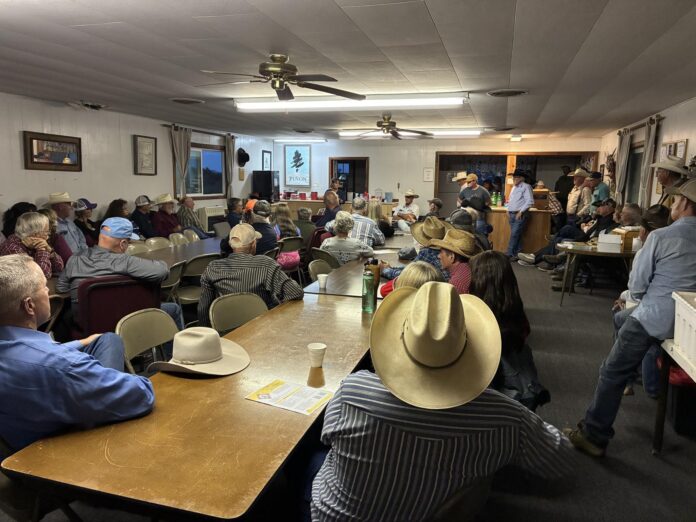
A town hall meeting was held at the Pinon Community Center on Oct. 23 to inform ranchers about the new livestock policies and allow them to ask questions. Holeck was the primary speaker at the meeting.
To move an animal out of the infested zone, a rancher must have them inspected by a veterinarian, livestock inspector, or cooperative extension agent and obtain a movement certificate, Holeck said.
Applications for movement certificates are reviewed and approved by the livestock board.
“This is fall shipping season,” Holeck said. “We know everybody’s going to be shipping a lot of cattle here soon, and we want to make sure that we’re helping you to get that done in a timely manner.”
There are additional standards to move animals out of state, as states receiving the animals require various forms of health documentation and screwworm preventatives.
“We don’t want to inadvertently take this with us,” Holeck said. “A minor infestation will blow up into a much bigger sore, with more maggots. And they might be dropping them out wherever they’re going. We don’t want to have that happen.”
She expected these restrictions to last at least 84 days — equal to four screwworm life cycles — but said that period could be abbreviated in the case of a freeze, as the parasites can’t survive cold temperatures.
“But we’re talking probably a week solid of freezing temperatures to get the ground cold enough to kill the pupa down in the soil,” Holeck said. “We might get cold weather — not cold enough to kill them — and then they’ll hatch out later and create more trouble. That’s why we keep those strategies in place for a long period of time: so that we can make sure we have got an area clear before we lift any restrictions.”
Screwworms are aggressive parasites whose larvae feed on living animal tissue, according to the U.S. Department of Agriculture (USDA). If left untreated, a screwworm infestation can kill a cow within a week or two, according to the National Cattlemen’s Beef Association.
Preventing the spread of screwworm among New Mexico livestock is a major priority for the USDA and NMDA.
“The worst-case scenario would be the pest becoming established and spreading across New Mexico, leading to widespread animal infestations, significant losses for livestock producers, costly control efforts and potential disruptions to animal movement and agricultural trade,” NMDA Public Affairs Specialist Jennifer Green wrote in an email to the Alamogordo News. “That is why early detection, rapid response and coordination with state and federal partners are essential.”
As a way of preventing further screwworm infestations, the USDA has a program to release sterile male screwworms in the wild.
“Sterile male screwworm flies mate with wild females so the resulting eggs do not hatch, helping suppress the population and limit its spread,” Green wrote. “USDA has expanded sterile fly dispersal capabilities in the region, having been able to reach further north and west into New Mexico.”
Though they can produce thousands of eggs in their lifetime, female screwworms are only fertilized once, Holeck said, making the introduction of sterile males the most effective means of lowering the screwworm population.
With the help of 500 million sterile males being released a week, screwworm was eradicated from the United States and much of Central America between 1957-2001, Holeck said. A population persisted in south Panama and has spread to North America in the last few years.
Darryl Brown, president of the Otero County Cattlemen’s Association, remembers screwworm infestations being a major problem in his youth.
“There are certain things you do on a ranch — when you’re castrating or dehorning or anything like that — that makes an open wound,” he said. “In the late 50s and early 60s, we did all kinds of things to prevent the screwworm larvae from landing in those wounds.”
Screwworms lay eggs in bodily openings — most often open wounds on livestock — although they can also infest the nose, mouth, eyes, or ears, according to the Center for Disease Control and Prevention (CDC).
They can infect pets, wild animals, and, on occasion, human beings.
At the Pinon meeting, one rancher asked if animal movement restrictions applied to pets.
“I’m moving with my French bulldog, I’m going to Las Cruces,” he said. “Do y’all need to come out and inspect it?”
“Ideally, we would like to look at it or have you work with your veterinarian on it,” Holeck responded. “People are going to travel with their pets. So, we’re trying to get that communication out to them again to travel as safely as possible because we don’t want their pets to create a risk to everything else.”
People from the infested zone traveling with pets to Colorado will need special documentation, she said.
Questions also arose about wild animals suspected of having a screwworm infestation.
Ranchers could be granted special authorization to kill these animals, New Mexico Wildlife Department’s Anthony Chavez said, unless the animal has special protections, like the bighorn sheep.
The NMDA advises animal owners — including the owners of dogs and cats — to closely monitor animals for “wounds that fail to heal, worsening injuries, maggots in wounds, foul-smelling discharge or unusual irritation around an injury.”
Lethargy or other unusual behavior can also be a sign of screwworm, Holeck said.
If any these signs of New World screwworm are detected, the NMDA advises the owner to contact the New Mexico Livestock Board (505-841-6161) and not to move the animal.
”We’ve been through it before, we’ll get through it again,” Holeck said. “This is not a zombie apocalypse where we’re going to have a bunch of Swiss cheese cows running around in the pastures.”