When discussing how a forest can bounce back after wildfire, cutting down trees is not always the first thought, but it is an important early step.
The U.S. Forest Service began post-fire recovery work, focused for now on fuel reduction and hazard tree mitigation, in the South Fork burn scar on Oct. 21 as a part of a larger recovery project for both the Blue 2 and South Fork burn scars.
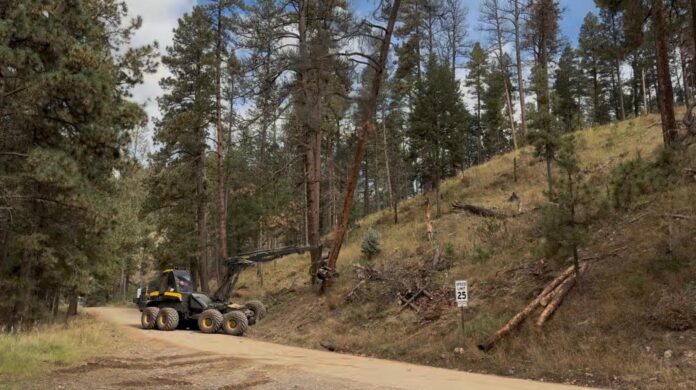
A pivotal element in the recovery is the removal of dead and dying trees — fuel reduction — across approximately 5,300 acres divided into nine blocks, according to Hayley Boss, a field technician with the Smokey Bear Ranger District, which is leading the fuel reduction elements of the project.
“The first foundational step to doing any kind of work in the forest is getting those snags and dead standing trees down,” Boss said.
The fuel reduction element of the larger recovery project carries a $38 million price tag, with work expected to continue through 2030 on both burn scars. Funding for the project comes from the American Relief Act.
Block 1 and Block 2, the closest to Ruidoso and nestled around Cedar Creek Drive, account for approximately 1,100 acres of the fuel work. Johnson Enterprises and Southwest Contracting are responsible for the tree removal work in the two blocks, according to Boss.
“We’re trying to get those trees cut, on the ground, and in a different arrangement where it’s going to be easier for us to fight fire and also promote a healthy forest,” Boss said.
The removal of dead and dying trees is called “fuel reduction” when the trees are not poising an immediate fall risk to people or structures near them, it becomes “hazard tree mitigation” when the trees pose such risk, according to Boss.
“With this project in Ruidoso and the South Fork Burn Scar, we’re basically trying to mitigate the hazard tree situation, because it was such a high severity fire; almost all the trees are dead in the burn scar,” Boss said.
Boss said that charred, dead and dying trees pose a safety risk to crew members, so fuel reduction and hazard tree work are some of the first elements being completed.
“We do have some requirements for keeping dead standing trees for wildlife, so a few of them will be standing for that, and then the trees that are still suitable for saw logs or fuel wood, we’ll be trying to take those out to get them get them sold,” said Boss.
The trees that are still left for removal will be masticated, or shredded, in either the original location or moved onto a bare slope to help reduce how quickly water can move across the ground and reduce damage caused to the soil by running water, often called erosion.
“We do have really strict guidelines about how much woody fuel we can leave on site,” said Boss. “It’s not like we’re just going to leave a ton of fuel on the ground. If there’s chips, they won’t be in excess of three inches.”
Those wood chips serve multiple important uses. If the burn scar does catch fire, a horizontally-burning fire created by the wood chips is easier to extinguish than the vertical flames of trees, according to Boss.
Wood chips can also help reintroduce nutrients into the dirt as they are absorbed into the ground over time.
“Getting some of those nutrients back into the soil, stabilizing some of those slopes as best as we can, reducing erosion, are all things that are going to make these sites a lot more successful when we do come in with the replanting efforts,” Boss said
Replanting efforts are expected to begin for Block 2 in 2029, according to the U.S. Forest Service.
Once seedlings are planted, the wood chips will help provide some protection from winter weather by acting as a thermal barrier, while also increasing the soil’s water retention, according to the USFS.
“I hope the public knows that our main priority is safety, both for the public and for our crews and our operators,” Boss said. “We are doing best to keep people working on the forest and doing our best to promote forest resilience, restoration, so that everyone can enjoy their recreation opportunities in the future.”