Proposed changes to federal air pollution controls drew the ire of New Mexico’s governor months before she leaves office in 2027.
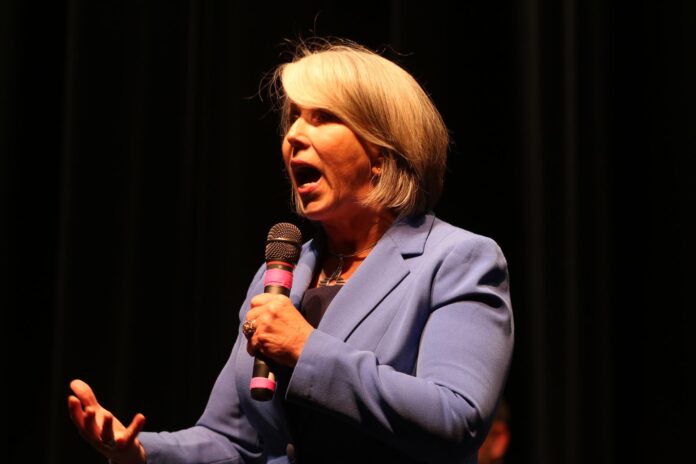
Democratic Gov. Michelle Lujan Grisham criticized the U.S. Environmental Protection Agency and its administrator Lee Zeldin after the agency announced Oct. 7 it intends to rescind federal requirements adopted to limit methane emissions caused by oil and gas production.
Lujan Grisham was first elected in 2018 and will complete her second and final term at the end of 2026. Candidates running in the Nov. 3 election to succeed Lujan Grisham are former U.S. Interior Secretary Deb Haaland, a Democrat, and Republican Gregg Hull, a former mayor of Rio Rancho.
One of Lujan Grisham’s signature policy goals, committing the state to “carbon-free” energy by 2045, was defined in an executive order she issued in January 2019, days after she took office. The New Mexico Legislature codified the policy as state law several months later when it passed the Energy Transition Act, which also created the Climate Change Task Force to study how various agencies could reduce environmental impacts such as air pollution.
Loosening federal rules contradicted the state’s priorities, the governor said. She accused the EPA of putting industry profits ahead of New Mexicans’ health.
“Rolling back federal standards means more pollution drifting into the lungs of families living next to wells and flares, and a hotter planet for all of us,” Lujan Grisham said in a statement.
Zeldin announced his agency’s proposal during a speech at the New Mexico Oil and Gas Association’s annual meeting in Santa Fe. The meeting brings together policymakers, industry leaders and supporters to discuss the state of oil and gas in New Mexico.
The trade group represents about 250 companies in all sectors of the state’s fossil fuel industry and frequently lobbies for industry-supportive policy at the state and federal level.
A public hearing on the EPA proposal was planned by December of this year with final approval expected in 2027.
If enacted the proposal would cancel a slate of oil and gas regulations put into effect Dec. 2, 2023, under the administration of former President Joe Biden. Cutting the rules, Zeldin said, would save the industry $45 million; in 2023, the EPA said enacting them would curb 58 million tons of methane emissions between 2024 and 2038.
The new rules would set different categories for marginal or low-producing wells, exempting the smaller operations from some of the federal requirements.
The EPA also hoped to cancel its “Super Emitter Program,” which allows the agency to identify certain well sites and facilities believed responsible for a large release of natural gas and add additional requirements tailored to specific incidents.
Other rules on the chopping block required the two-year phaseout of routine flaring, or the burning of excess natural gas, and a one-year phase-in of low- or zero-emission pumps at oil and gas sites throughout the U.S.
Another major provision among the rules targeted for cancellation was one imposing the same requirements for existing oil and gas facilities as for new developments, meaning they must be retrofitted if equipment is noncompliant.
During his speech, Zeldin blamed the previous administration’s policy for high gasoline prices and home energy costs.
“Americans must be able to afford to heat their homes in the winter and fill up their car and drive to work,” he said. “They can’t do that when the people producing the energy are weighed down by unnecessary burdens. The Trump EPA is committed to fixing this so the U.S. can reach its full energy potential.”
In response, Lujan Grisham pointed to tighter air emission restrictions enacted by the State of New Mexico’s Environment Department and Energy, Minerals and Natural Resources Department in 2021.
The natural resources department’s rule called for the end of routine flaring and required that oil and gas producers capture 98% of produced gas by the end of 2026. The environment department implemented new reporting, leak detection and repair requirements specifically aimed at methane and volatile organic compounds that generate ground-level ozone or “smog” when exposed to sunlight.
New Mexico also proposed in July its own super emitter program modeled after the EPA’s, along with new requirements for zero-emission pumps and controllers at oil and gas sites in the state.
“Our methane rules will remain firmly in place, and we’re planning to strengthen them while collaborating with other states to share our nation-leading best practices,” Lujan Grisham said.
The tougher rules not only reduced methane intensity– the amount of gas emitted per the number of sites – on the New Mexico side of the Permian Basin to “less than half of Texas,” Lujan Grisham said, but also resulted in the capture of additional gas worth $125 million.
That was while the state’s oil and gas production more than doubled since 2020, she said.
“Fortunately for New Mexicans – and the planet – our state has charted a better course while proving that stringent standards work,” Lujan Grisham said.
Advocacy groups in New Mexico condemned the federal proposal, contending it would cause more air pollution to drift into New Mexico from states with less stringent state rules.
“As New Mexico strengthens methane protections, federal rollbacks put our progress and our kids’ health at risk,” said Maya Anthony with New Mexico Voices for Children. “Communities near oil and gas production face greater exposure to pollution.”
New Mexico Oil and Gas Association President Missi Currier said the group was analyzing the EPA’s proposed rollback and supports “clean, reliable, affordable energy, and practical policies that reduce emissions, protect public health, and provide certainty for energy producers and consumers.”
Managing Editor Adrian Hedden can be reached at 575-628-5516, or @AdrianHedden on the social media platform X.