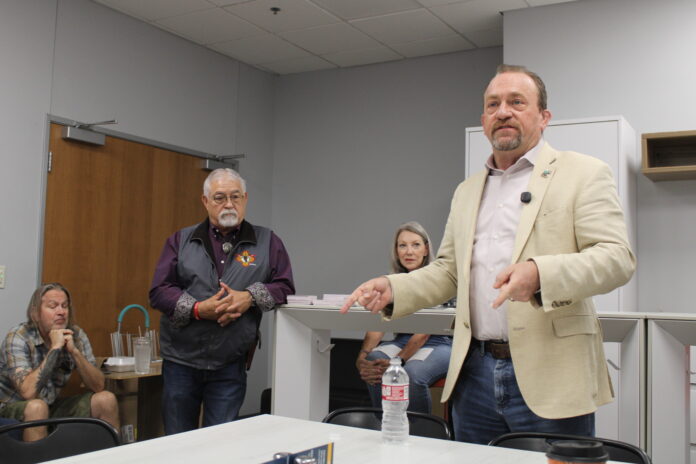
Republican governor nominee Gregg Hull defended his recently released tax plan at a campaign stop Tuesday, Oct. 13 in Roswell.
Hull spoke to an audience of about 50 at the Valley Cafe about his “Four Steps to Zero” proposal to phase out New Mexico’s personal income tax.
A former Rio Rancho mayor, Hull is running against Democrat and former Interior Secretary Deb Haaland in the Nov. 3 election. The winner will succeed term-limited Gov. Michelle Lujan Grisham, a Democrat, who will leave office in 2027.
Hull’s proposal, which would require approval from the Legislature, aims to end the state’s personal income tax in four steps over four years, according to a news release issued Oct. 5 by the Hull campaign. The plan would end the tax on qualified wages, retirement income and personal investment income.
Under the proposal, the first step would end the personal income tax on the first $25,000 of annual income for individual filers and first $50,000 for married couples filing jointly, according to a fact sheet about the plan on the Hull campaign’s website.
This would have the effect of subtracting $25,000 from an individual’s annual taxable salary, or $50,000 for joint filers, then charging the tax based on the remainder. People making $25,000 or less would not pay any income tax.
The plan’s second and third steps would raise the income thresholds. Under the second step, the tax would end on the first $50,000 of income for individual filers and the first $100,000 of income for joint filers. The third step would end the tax on the first $100,000 of income for individual filers and the first $200,000 for joint filers. The fourth step would complete the phaseout by ending the tax on all eligible personal income, according to the fact sheet.
New Mexico currently has a six-bracket personal income tax system. The rates range from 1.5% on incomes of up to $5,500 for individual filers and $8,000 for married couples filing jointly, the lowest bracket, and to the highest rate, which is 5.9% on incomes of $210,000 or more per year for individual filers and $315,000 or more for married couples filing jointly, according to figures from the New Mexico Taxation and Revenue Department.
At the Roswell event, Hull said the state government has increased spending dramatically in recent years and is collecting more revenue than it needs.
Recurring general fund revenue for fiscal year 2028, is projected to be $14.8 billion, according to the Legislative Finance Committee website. That is above the $11.1 billion in recurring general fund spending authorized in FY27. The FY28 budget, which would take effect July 1, 2027, will be written and considered in the 60-day legislative session that begins in January.
Fiscal years run from July 1 to June 30 of each year, named for the calendar year they end in.
The personal income tax is expected to account for $2.99 billion, or 20.24% of recurring general fund revenue in FY28, according to the Legislative Finance Committee.
“That means we’re overcharging the citizens of New Mexico,” Hull said. “It’s time to take some of that money and put it back into the pockets of the citizens that are paying for all these services.”
Hull’s plan also requires that core state services including schools, health care, public safety and social safety net programs all be funded before moving on to the next step.
The plan would be paused if the state cannot meet those obligations, according to the news release from Hull’s campaign. If the plan cannot move forward, Hull would instead end state taxes on Social Security benefits and military pensions, according to the fact sheet.
Haaland’s campaign criticized the proposal Tuesday.
“Deb plans to use state resources to invest in the state long term, address affordability issues as families are struggling to make ends meet, and put money back in people’s pockets. Hull’s tax plan is simply setting the state up to fail and will only benefit New Mexico’s wealthiest,” Hannah Menchhoff, communications director for the Haaland campaign, wrote in response to an email inquiry.
The Race
With three weeks remaining until Election Day, Hull told the Roswell audience that he believes that the race is winnable and that a strong turnout in reliably Republican southeastern New Mexico could make the difference.
“We’ve seen the registered voters down here that have not turned out to vote in previous elections,” Hull said. A greater turnout in southeastern New Mexico, he added, could have helped Republican Mark Ronchetti unseat Lujan Grisham in 2022. That year, statewide turnout was 53% and Lujan Grisham won reelection 52% to 46%.
Hull portrayed the race as a chance for New Mexico to change course after eight years of Democratic dominance.
“In three weeks, the state will make a decision whether we’re going to stay on the same path or we’re going to turn to a better direction by electing me as your next governor,” he said.
An Albuquerque Journal poll of 1,125 likely voters released Sunday showed Haaland leading Hull 49% to 42%. Another 9% were undecided. The poll was conducted by Albuquerque-based polling firm Research & Polling Inc. from Oct. 1 to 9 and has a margin of error of 2.9 percentage points, according to a story in the Journal.
The Cook Political Report, a nonpartisan political newsletter that ranks competitive election contests, has rated the New Mexico governor’s race as “Solid Democrat,” a designation that means the race is not considered competitive.
But Hull sees momentum in his favor, particularly in northern New Mexico, where he said many moderate Democrats are disenchanted with the more progressive wing of their party and are willing to cross over to support him.
“I think we’re going to see a big shift up there. I really do,” Hull said.