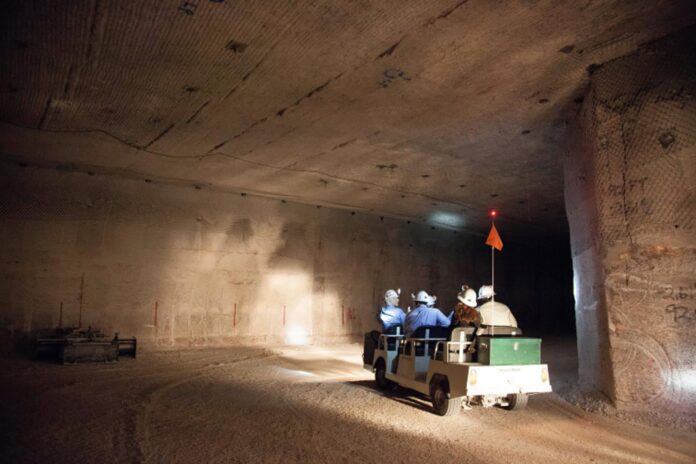
Nuclear waste shipments to a repository near Carlsbad from a facility in Washington where atomic weapons were developed will resume after a 15-year pause.
The federal Hanford Site was established in 1943, and produced plutonium used in nuclear weapons until 1971 when the production was decommissioned.
Cleanup efforts at the site in Benton, Washington continued in the decades since and today it hosts a nuclear power plant and multiple research facilities such as the federal Pacific Northwest National Laboratory.
The site is also part of the three-location Manhattan Project National Historical Park, including Los Alamos National Laboratory in northern New Mexico and Oak Ridge National Laboratory in Tennessee.
Amid ongoing cleanup operations at Hanford, transuranic (TRU) nuclear waste was sent to the Waste Isolation Pilot Plant in southeast New Mexico starting in July 2000 until shipments were paused in 2011 “due to other shipment priorities,” read an Aug. 25 news release from the U.S. Department of Energy.
These priorities were from other federal facilities such as Idaho National Laboratory, for which half of WIPP’s shipment capacity is set aside via a settlement agreement between the federal government and the state of Idaho.
WIPP also prioritizes the Savannah River Site in South Carolina where the National Nuclear Security Administration plans to produce up to 50 plutonium pits per year by 2030 as part of a federal effort to rebuild U.S. weapons stockpiles.
Yet, in 2018, federal workers began exhuming waste buried at Hanford during the nuclear arms race and Cold War and preparing it for shipment to WIPP. The characterization process, when the dug-up waste is analyzed for its contents to ensure shipments meet WIPP’s requirements for disposal, began earlier this year, according to the new release.
“The certification process is critical to safely and compliantly packaging and shipping transuranic waste to WIPP for permanent disposal,” said Acting Assistant Manager Scott Green at the DOE’s Hanford Field Office.
The waste generated during past plutonium production activities is currently stored at Hanford in about 11,000 containers, mostly 55-gallon drums compliant with WIPP protocols for disposal.
The containers will be inspected visually by WIPP officials at Hanford, and then analyzed for their radioactivity, checked for any flammable material or gasses and studied for several other criteria required for shipment.
Ron Reeves, transuranic waste program activity manager at Central Plateau Cleanup Company, the DOE-hired contractor running Hanford’s nuclear cleanup operations, said the facility was “well positioned to resume waste shipments in the near future.”
Don Hancock at Albuquerque-based government watchdog group Southeast Research and Information Center, said doing so would disregard the needs of WIPP’s host state and potentially run afoul of state policy.
The center advocates for several federal and state policy issues that impact New Mexico and frequently offers criticisms of WIPP’s operations in government documentation and stakeholder meetings.
Hancock, director the center’s Nuclear Waste Program, said the federal government continued to emphasize out-of-state nuclear waste rather than waste in need of disposal at Los Alamos National Laboratory in northern New Mexico.
Los Alamos is where federal scientists developed the nation’s first nuclear weapon, which was tested a few hours’ drive south at the Trinity Site near Socorro as part of the Manhattan Project in 1945. Legacy waste from that project and continued weapons development at Los Alamos over subsequent decades remains onsite and in need of disposal.
Hancock argued that disposing of the Los Alamos waste would benefit the people of New Mexico who host the WIPP repository and are most vulnerable to any risks associated with the site, which officials said could be open until 2080.
“Rather than putting more emphasis on Los Alamos, which they are not doing, they are putting it on Hanford,” Hancock said of the Department of Energy. “That’s coming from the state of Washington and people that want their waste addressed. The DOE needs to weigh these priorities.”
A clause requiring prioritization of Los Alamos waste was added to WIPP’s state operations permit when it was renewed in 2023 following negotiations between the state and the federal government, but New Mexico officials contend the requirement is not being met.
In response, a modification to the permit was proposed by the New Mexico Environment Department in April stipulating that by 2027, Los Alamos waste must make up 55% of all shipments sent to WIPP.
Managing Editor Adrian Hedden can be reached at 575-628-5516, or @AdrianHedden on the social media platform X.