Almost 80% of the oil pumped on U.S. public land comes from southeast New Mexico.
Together, Eddy and Lea counties generated 1.3 million barrels of oil per day on federal public land, 78% of the nation’s total output from the lands, according to national oil and gas trade group the American Petroleum Institute.
Notably, the federal government in May sold $4 billion in leases on public land to the oil and gas industry in the Carlsbad area.
Operations and quarterly lease sales are managed by the Bureau of Land Management and its Carlsbad Field Office, which oversees lands in Eddy and Lea counties.
For all its lease sales, the bureau provides half the revenue to the host state, meaning the state of New Mexico received $2 billion from the May sale.
Matt Warren, National Oil and Gas Program Lead at the bureau, said fossil fuel operations on the New Mexico side of the Permian Basin led the nation’s energy development.
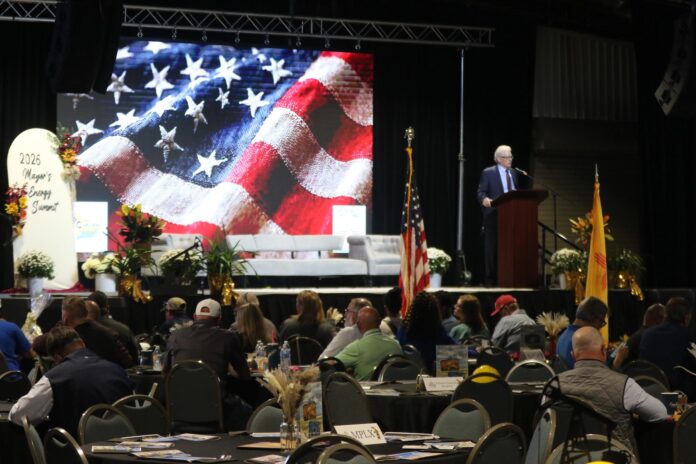
His comments came during the Carlsbad Mayor’s Energy Summit held Thursday, Oct. 22, at the Walter Gerrells Performing Arts Center.
The annual gathering hosted by the city of Carlsbad brings together local government leaders, oil and gas executives and workers and others for a day of talks on the extraction industry’s influence on the region and the latest policy developments.
Warren said 3.1 million of the 4.1 million acres managed by the Carlsbad Field Office were being used to produce oil and gas from more than 22,00 wells.
“There’s a lot of things coming out of this basin. Carlsbad is the busiest office we have when it comes to oil and gas,” Warren said. “The Permian Basin is significant when it comes to overall national oil and gas production.”

Carlsbad the ‘busiest’ in the nation
The Carlsbad office was the busiest in the U.S., Warren said, with 3,277 applications to permit drilling approved in fiscal year 2026 compared with 4,647 applications received nationwide.
An application is one of the final steps before drilling can commence. Warren said that since 2024 the bureau has reduced the time it takes to approve an application from 300 days to less than 100.
He credited President Donald Trump’s January 2025 executive order titled “Unleashing American Energy,” which called on federal agencies to roll back regulations such as environmental requirements with the goal of boosting industrial development.
Key among changes to federal oil and gas policy under the Trump administration was a cut in the royalty rate paid to the government by oil and gas operators as a percentage of their proceeds from oil and gas leases.
In Trump’s signature tax bill, known by supporters as the “one big, beautiful bill,” the royalty rate was cut from 16.67% to 12.5% in a move industry supporters said would encourage more production on federal land, as opposed to private land where no royalty is charged.
Warren also pointed to a significant change in how the Environmental Protection Agency manages industry-related air pollution. EPA Administrator Lee Zeldin earlier this month proposed canceling a slate of oil and gas regulations put into effect in 2024 under the administration of former President Joe Biden.
Cutting the rules, which had added requirements to phase out the burning of excess gas – a process known as flaring – and phase in the use of electric or zero-emission pumps at oil and gas sites across the U.S., would save the industry about $45 million per year, Zeldin said.
When the rules were proposed in 2023, the EPA said enacting them would curb 58 million tons of methane emissions between 2024 and 2038.
Warren said the recent rule changes were part of a trend of removing barriers to oil and gas production in the U.S.
“It’s part of what we’re doing to not slow the industry down so we can get this oil and gas out of the ground,” he said. “We’re reducing unnecessary compliance burdens. There’s a lot moving, and there’s a lot that’s going to continue to move.”
‘A massive impact’
Carlsbad Mayor Rick Lopez said that as of the day of the summit Eddy County had 47 operational oil and gas drilling rigs, the most in the nation, followed by Lea County with 46 rigs.
Overall, the Permian accounted for about 47% of the nation’s drilling rigs. New Mexico’s 96 rigs as of Oct. 16 ranked second to Texas’ 278, according to the latest report from Baker Hughes – a Houston-based oil field services company that provides industry-wide data such as weekly rig count updates by state and region.
The next-highest rig count was 50 in Oklahoma, Baker Hughes reported.
Eddy and Lea share the Permian with West Texas and keyed New Mexico’s ranking as second to Texas in U.S. oil production, according to the Energy Information Administration.
The Permian averaged about 6.9 million barrels per day, more than half of the United States’ total output, according to the Administration.
All that production generated about $13 billion in revenue for state and local governments across New Mexico in FY 2026, according to trade group the New Mexico Oil and Gas Association.
“The operations that happen here in the Permian Basin have a massive impact on the national level,” Lopez said.
Thomas Clifford, president of Albuquerque-based Clifford Consulting, a financial consulting firm that works with the industry and state government, said the statewide benefit from Permian oil and gas was “significant.”
Clifford pointed to the state’s recently enacted Universal Childcare program, which removed the income maximums for New Mexico’s Childcare Assistance Program, effectively offering funding to all income levels for free childcare.
He said such public services were largely supported by the oil and gas industry, which Clifford said accounts for one-third of all taxes paid in New Mexico.
“Universal childcare is an oil and gas program,” Clifford said. “That would not be possible without the revenue from oil and gas.”
Managing Editor Adrian Hedden can be reached at 575-628-5516, or @AdrianHedden on the social media platform X.