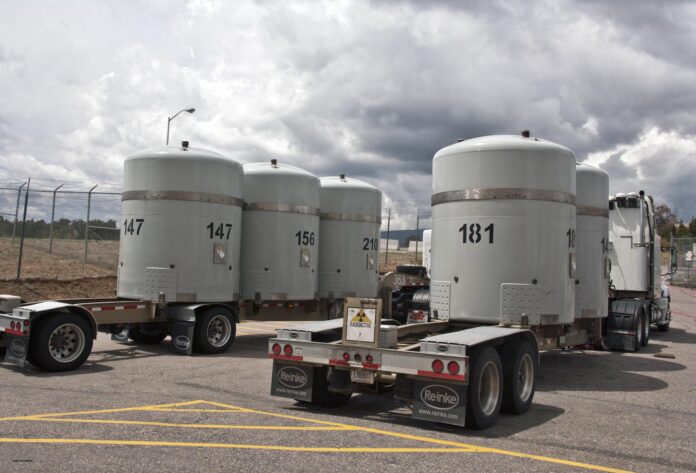
A lab in South Carolina will start shipping highly radioactive waste to a nuclear repository near Carlsbad.
The Savannah River Site, a federal nuclear research facility near Aiken, South Carolina, announced Aug. 10 it would begin shipping the waste for disposal at the Waste Isolation Pilot Plant. The announcement came after the lab completed an analysis checking for flammable gasses within several containers.
The containers were cleared by Savannah River Nuclear Solutions, the contractor hired by the U.S. Department of Energy to oversee nuclear cleanup at the site and will be shipped via truck to WIPP for final disposal.
At WIPP, the Energy Department disposes of transuranic nuclear waste (TRU), which is clothing materials, equipment and other debris irradiated during nuclear activities.
The waste is buried at WIPP in a salt deposit about 2,000 feet underground. The salt gradually collapses on the waste, burying the refuse and blocking radiation from escaping.
But before the waste from Savannah River – considered “remoted-handled waste” – could be sent to WIPP the material underwent a process known as “flammable gas sampling,” which analyzes the gasses present in each container to determine the risk of internal combustion should it be moved.
Remote-handled waste carries a higher dose of radiation, 200 millirems or more per hour. It was traditionally handled only via machine due to its higher dose than that of “contact-handled” waste, which contains less than 200 millirems per hour.
Contact-handled waste makes up about 96% of the refuse disposed of at WIPP, read a news release from the Department of Energy.
A standard TV screen emits about one millirem of radiation per hour, according to the Nuclear Regulatory Commission.
Shielded containers approved for use in 2024 allow remote-handled waste to be disposed of in the underground using the same methods as contact-handled waste.
Debate on waste from out of state
Aside from the elevated radiation levels of the waste recently approved, the gas analysis was “especially important,” read a statement from Savannah River, as the containers were also considered “legacy waste” left over at federal facilities from the Cold War and other past nuclear proliferation.
That’s because legacy waste is often old, stored on-site for many years, and potentially generates flammable gasses over time depending on the contents.
“The characterization of these containers is essential to meet our mission of shipping these transuranic waste containers out of South Carolina and getting them to permanent disposition at the WIPP facility,” said Anthony Carraway, a manager with Savannah River Nuclear Solutions.
Savannah River is the second-highest active shipper of waste to WIPP with 1,862 shipments since the repository opened in 1999. That’s just ahead of Los Alamos National Laboratory in northern New Mexico with 1,845, but less than a third of top shipper Idaho National Laboratory’s 7,840 shipments to WIPP.
Rocky Flats Environmental Technology Site in Denver sent 2,045 shipments to WIPP before the site was decommissioned in 2006.
The high percentage of nuclear waste sent to WIPP from outside New Mexico recently drew the ire of the New Mexico Environment Department, which oversees WIPP’s 10-year state permit to operate.
The permit was last renewed in 2023 with an added provision that WIPP “prioritize” legacy waste from Los Alamos, with the 12th and final permitted disposal panel in the underground set aside for such waste.
Panels are mined out areas in the WIPP underground where drums of waste are placed for disposal. The permit gives approval to mine out the site’s 11th and 12th panels; the previous permit approved only eight.
In response to continued dissatisfaction with the federal government’s alleged lack of priority for New Mexico waste, the state’s environment department in April proposed another modification to the permit requiring that 55% of WIPP’s waste come from Los Alamos by 2027, and 75% by 2032.
The modification was opposed by the U.S. Environmental Protection Agency, with Region 6 Administrator Scott Mason submitting a letter to the state arguing the proposal raised “significant concerns” and threatening a “presidential waiver” from President Donald Trump if New Mexico continued to pursue the change.
But Environment Department Cabinet Secretary James Kenney maintained that the proposal was critical to “protect the health and safety of communities across the United State, including New Mexicans.”
Managing Editor Adrian Hedden can be reached at 575-628-5516, or @AdrianHedden on the social media platform X.